
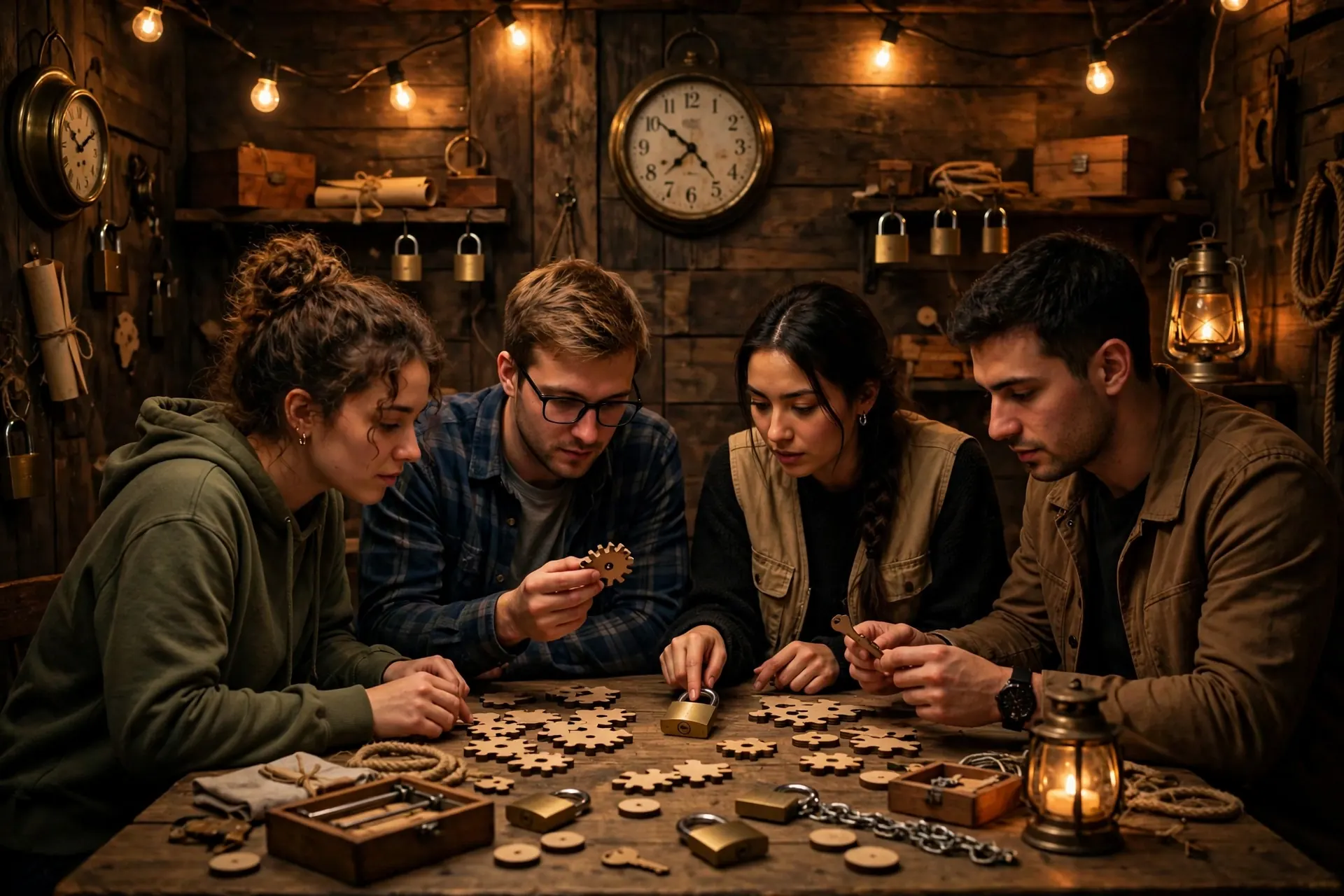
An escape room near me is a live puzzle game where you and your team are placed in a themed room and given a set time, usually an hour, to find clues, solve puzzles, and complete a mission before the clock runs out. You might be escaping a prison cell, defusing a bomb, solving a murder mystery, or hunting for lost treasure, and every hidden drawer, coded lock, and cryptic message brings you closer to the exit. It is part game, part theatre, and part team challenge, and it works just as well for a birthday, a date night, or a work social as it does for a casual evening with friends. This guide explains how escape rooms work, how to find a good one near you, and how to make your first game a success.
What Is an Escape Room?
An escape room is a real-life adventure game in which a small group of players works together to solve a series of puzzles inside a decorated, themed space, with the goal of completing the mission within a time limit. Most rooms hold between two and eight players, and the puzzles are designed so that no single person can solve everything alone, which is why communication and teamwork matter more than individual cleverness. The game master watches your progress on cameras, gives hints when your team stalls, and keeps the story moving so the experience stays fun rather than frustrating.
The themes vary enormously, and that variety is a large part of the appeal, because you can pick a room that matches your group’s mood and interests. Horror rooms with dim lighting and sudden scares suit thrill-seekers, while detective and mystery rooms appeal to players who love logic and deduction, and adventure rooms with treasure maps and ancient temples work well for families. Some venues build elaborate sets with moving walls, secret passages, and sound effects, while others rely on clever puzzles in a simpler space. Breakout Games also publishes a beginner guide that covers the same basics, including how hints work and what first-time players should expect, and it is another useful read before you book: https://breakoutgames.com/blog/what-is-an-escape-room
The Escape Game, one of the largest escape room operators, describes the format as a fully immersive adventure where players solve puzzles together to complete a mission, and its guide is a useful starting point if you want to understand the basic concept before booking. You can read it at https://theescapegame.com/blog/what-is-an-escape-room/ to see how a typical game is structured.
How Do I Find the Best Escape Room Near Me?
Finding the best escape room near you starts with a quick local search, but the results need a little filtering, because quality varies far more between venues than the star ratings sometimes suggest. Look for venues with a large number of recent reviews rather than a handful of perfect scores, and read the written comments for details about the puzzles, the set design, and the game master’s help. A good venue will have several different rooms with clear difficulty ratings, age guidance, and player limits, plus photos or videos that show the actual sets rather than stock images. Check whether the venue is independently owned or part of a chain, since both can be excellent, but independent rooms often have the most original themes while chains tend to offer consistent quality and polished sets.
Before you book, compare a few practical details that affect the experience more than the price does. Ask whether the game is private, meaning only your group plays, or whether strangers may be added to fill the room, because a private game is almost always better for birthdays and team events. Check the location, parking, and public transport options, and confirm the cancellation policy in case someone in your group drops out. It also helps to look at the venue’s social media or review photos from real players, which often show the rooms more honestly than the official website. Finally, consider the difficulty level carefully: a room rated easy or medium is the right choice for a first visit, while the hardest rooms are designed for experienced teams and can leave beginners stuck and frustrated. A venue that is honest about difficulty is usually honest about everything else too.
What Happens Inside an Escape Room?
When you arrive at an escape room venue, your group is welcomed by a game master who explains the rules, the story, and the safety information before the game begins. You will usually be asked to store phones and bags in a locker, since outside help would spoil the puzzles, and you will be told how to ask for hints and how to leave the room at any time if someone feels uncomfortable. The game master then leads you into the room, sets the scene with a short story or video, and starts the countdown, which is usually sixty minutes. From that moment, your team searches the room for clues, opens locked boxes, decodes messages, and pieces together the story, with each solved puzzle revealing the next step toward the final goal.
The puzzles themselves come in many forms, and a good room mixes them so that different players can shine at different moments. Some puzzles are physical, such as finding a hidden key or moving a bookcase to reveal a passage, while others are logical, such as cracking a code from a set of numbers or matching symbols to a pattern. You may need to listen to an audio clue, shine a torch into a dark corner, or work out a riddle from a painting on the wall. If your team gets stuck, the game master offers a hint, either through a screen in the room or over a speaker, and most venues allow unlimited hints, though some count them against your final time or score. When the clock runs out or you escape, the game master debriefs your team, explains any puzzles you missed, and usually takes a team photo, which is why many players book again the moment they leave.
How Much Does an Escape Room Cost?
Escape room prices vary by city, venue, group size, and the day of the week, so there is no single price that applies everywhere, and the best way to budget is to check a few local venues before you book. Most venues charge per person, and the per-person rate often falls as your group gets bigger, while a few venues charge a flat rate for the whole room regardless of how many players join. The best way to budget for an escape room near me is to check a few local venues before you book, since weekend evenings and peak holiday slots are usually the most expensive, while weekday afternoons and off-peak sessions can be noticeably cheaper, which makes a midweek game a smart choice if your group is flexible. Some venues also offer discounts for students, large groups, or repeat visits, so it is worth asking about deals before you pay full price.
When you compare prices, remember that the cheapest room is not always the best value, because a poorly designed room with weak puzzles can feel like a waste of money at any price. A well-built room with an immersive set, a thoughtful story, and a helpful game master is worth paying more for, especially for a special occasion. Check what is included in the price before you book: a private game, a team photo, and a debrief are standard at good venues, while some charge extra for photos or for adding players at the last minute. Booking directly through the venue’s own website is usually the simplest option, and it often gives you the clearest view of available times and prices as of November 2026.
Are Escape Rooms Good for Families and Kids?
Escape rooms can be excellent fun for families, but the experience depends heavily on the theme, the difficulty, and the ages of the children in your group. Many venues offer family-friendly rooms with adventure or mystery themes, puzzles that children can help solve, and no scary content, and these rooms are designed so that younger players can contribute rather than just watch the adults work. The best family rooms mix physical searching, which children are often good at, with logic puzzles that adults can guide, so everyone feels involved. Some venues set a minimum age, often around seven or eight for family rooms, and require an adult to play alongside younger children, so check the age guidance on the venue’s website before you book.
Horror rooms, on the other hand, are generally not suitable for young children, because they use darkness, loud sounds, and sudden scares that can be genuinely frightening. If you are booking for a family, choose a room that is clearly labelled family-friendly, read reviews from other parents, and call the venue if you are unsure whether the theme is appropriate for your children’s ages. Also think about group size: a room built for eight players can feel empty with only three, while a small room can feel cramped for a large family. Most venues are happy to advise which of their rooms suits a family group best, and a quick call can save you from booking a room that is too hard, too scary, or too big for your children. When the room fits the family, an escape game becomes one of those rare activities that teenagers, parents, and grandparents all enjoy together.
Escape Room Tips for First-Time Players
First-time players often make the same mistakes, and a few simple habits can turn a confusing first game into a confident escape. The most important tip is to communicate constantly, because puzzles are designed for a team, and a clue that means nothing to you might be the missing piece for someone else. Call out everything you find, read clue text aloud, and keep discovered items in one visible place so the team can see what it has already collected. Search the room thoroughly in the first few minutes, opening every drawer, checking under furniture, and looking behind pictures, because early clues are often hidden in plain sight and missed by teams that rush straight to the hardest puzzle.
Another useful habit is to work on more than one puzzle at a time, since a good room usually has several puzzles open at once, and splitting into pairs lets your team make progress on different threads. Do not be afraid to ask for hints, because the game master wants you to enjoy the experience, and a well-timed hint keeps the game moving rather than letting your team stall for ten minutes on one lock. Finally, watch the clock without panicking, because the last ten minutes are often the most exciting part of the game, and many teams escape in the final moments. If you follow these tips, your first visit to an escape room near me is far more likely to end with a win and a booking for the next room.
Escape Rooms for Team Building and Parties
Escape rooms have become a popular choice for team building and parties because they reveal how people work together under pressure in a way that a meal or a meeting never can. For work teams, the game shows who takes the lead, who spots details, and who stays calm when the clock is running down, and a good debrief afterwards can turn those observations into a genuinely useful conversation. Many venues offer corporate packages with multiple rooms running at the same time, so larger teams can compete against each other, plus a meeting space, refreshments, and a facilitator who leads the debrief. The shared challenge also breaks down hierarchies, since a junior employee can solve the puzzle that saves the team, which is why managers often choose escape rooms over more formal team exercises.
For birthdays, hen parties, and celebrations, escape rooms work because they give the group a shared story to talk about long after the game ends. Most venues let you book a private room, add a cake or decorations, and take a team photo, and some offer party packages that include food or a reserved lounge area. When you are booking for a party, choose a room with a difficulty that suits the whole group rather than the most experienced player, and confirm the player limit so nobody is left out. It is also worth booking early for weekend slots, which fill up weeks in advance in popular cities. Whether the occasion is work or celebration, the best escape room for your group is the one where everyone contributes, everyone has fun, and the team leaves already planning its next game.
Conclusion
An escape room is one of the simplest ways to spend an hour doing something genuinely different, and the best local venues make the experience feel like stepping into a film for sixty minutes. The key is to choose a room that fits your group, whether that means a family-friendly adventure, a challenging mystery, or a party-ready game with friends, and to book a private session at a venue with strong recent reviews. Read the difficulty rating honestly before you book, because a room that matches your group’s experience is far more fun than one that leaves you stuck.
Communicate with your team, search thoroughly, ask for hints when you need them, and enjoy the pressure of the countdown rather than fighting it. Once you have played your first game, the search for an escape room near me usually turns into a habit, with each new room offering a fresh theme, a new set of puzzles, and another hour of teamwork that is far more memorable than an ordinary night out. Most players leave their first game already comparing notes about which room to try next, and that shared excitement is the real reason escape rooms keep growing.
Are You Really Locked Inside an Escape Room?
No, you are not really locked inside an escape room, and every reputable venue has a clear way for players to leave at any time. Most rooms use a door that can be opened from the inside, or an emergency exit button, and the game master is watching your group on camera throughout the game. The locked door is part of the story, not a real restriction, and if anyone feels uncomfortable, claustrophobic, or unwell, they can step out immediately without ending the game for the rest of the team.
Before the game starts, the game master explains exactly how to leave, where the emergency exit is, and how to signal for help. If you or someone in your group worries about small spaces, tell the venue when you book, and ask whether the room has windows, a spacious layout, or a way to play with the door open. Venues take this seriously because player comfort is part of the design, and a game master would rather pause a game than have a player feel trapped or distressed.
What Happens If Our Team Gets Stuck?
If your team gets stuck, the game master steps in with a hint, and that is a normal part of the game rather than a failure. Most venues allow unlimited hints, delivered through a screen in the room or over a speaker, while a few limit the number of hints or add a small time penalty for each one. The game master watches your progress and usually offers a nudge before your team loses too much time on a single puzzle, so you rarely sit stuck for long.
Asking for a hint does not spoil the fun, because the hint usually points you toward the right clue rather than giving away the answer, and it keeps the game moving so you can reach the later puzzles. Teams that refuse hints often run out of time on the first puzzle and miss the best parts of the room, so treat hints as part of the design. Think of hints as part of the game design, not a penalty, since even experienced teams use them on the hardest rooms.
How Long Does an Escape Room Game Last?
Most escape room games last sixty minutes, which is the standard length at the majority of venues, though some rooms run for forty-five minutes and a few larger or more complex games last seventy-five or ninety minutes. Your visit as a whole usually takes around ninety minutes, because you need time for the briefing before the game, the game itself, and the debrief and photo afterwards. That extra time matters, because rushing the briefing means missing rules that could cost you clues later in the game.
Arrive at least fifteen minutes before your booked start time, since late arrivals can lose playing time and may not be able to start if the next group is already waiting. If you are booking for a party or a team event, allow extra time for food, photos, and the debrief, and check with the venue whether the room you have chosen runs for the standard hour or a different length. If your group is running late, call the venue straight away, since many venues can shift a start time if the next slot is still free.
What Should I Wear to an Escape Room?
Wear comfortable clothes and flat shoes that you can move around in, because escape rooms involve searching, bending, reaching, and sometimes crawling through a passage or crouching behind furniture. Avoid skirts, high heels, and anything you would not want to get dusty, since some rooms have low ceilings, narrow gaps, and props that require you to kneel or stretch. Comfort matters more than style here, since you will be on your feet and moving for the full hour, from the first clue to the final lock.
Leave valuables and large bags at home or in the lockers provided, because you will be moving around the room and will not want to carry anything extra. If the room has a horror theme, expect dim lighting and sudden sounds, so dress for comfort rather than style, and tie back long hair if the room involves crawling or close quarters. The venue will tell you if a particular room has any special requirements, such as removing shoes, so check when you book. A quick call to the venue before you visit will confirm any dress rules for the specific room you booked.