
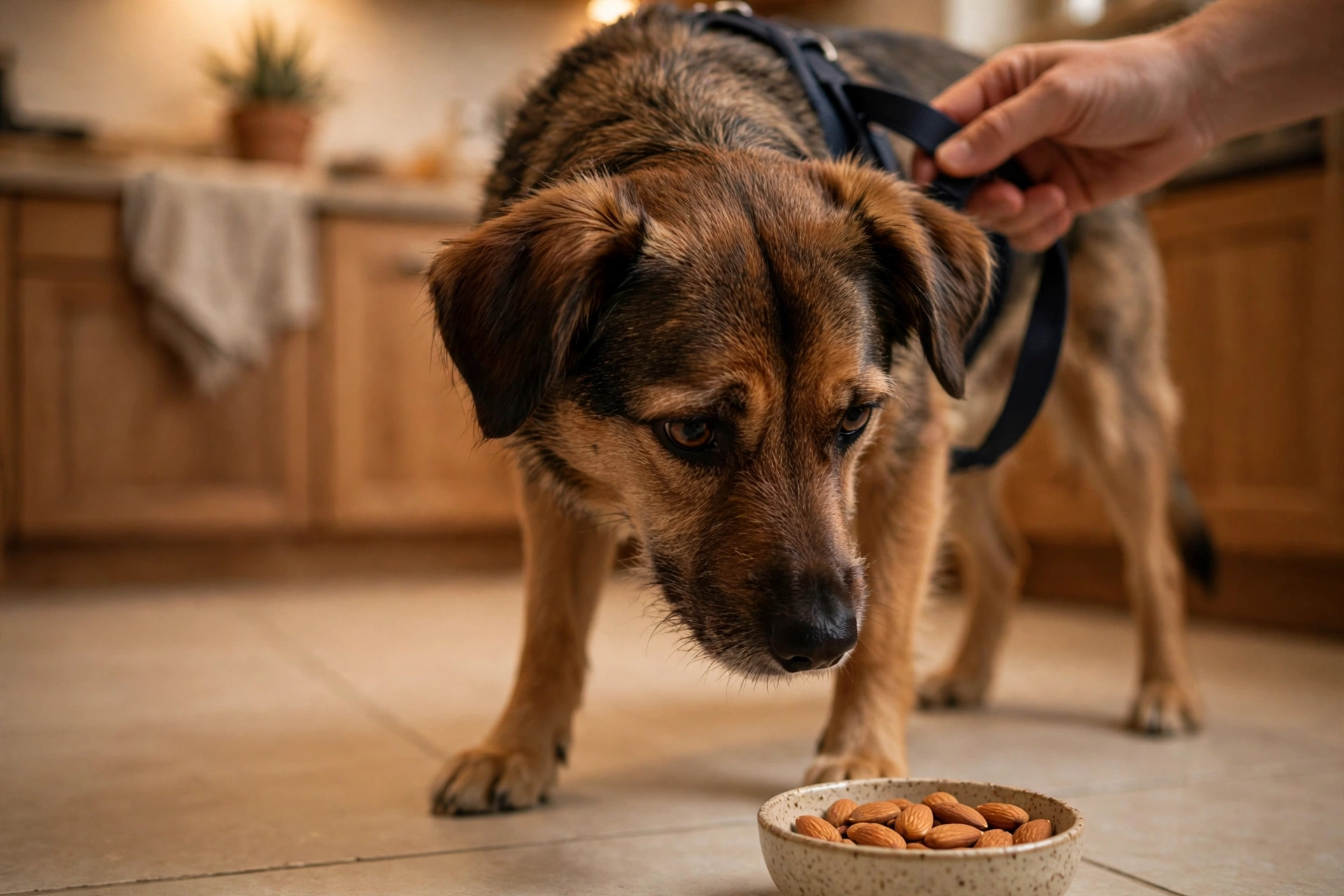
Can Dogs Have Almonds? The Vet Advice Every Owner Should Know
Can dogs have almonds? The short answer is no, dogs should not be given almonds, because although almonds are not classed as toxic to dogs in the way macadamia nuts are, they are hard for dogs to digest, high in fat, and the right size and shape to choke a dog or block its gut. The American Kennel Club gives a clear answer of no to this exact question, and the ASPCA Animal Poison Control Center lists nuts, including almonds, among the people foods to avoid feeding pets. A single plain almond that a dog snatches off the floor is unlikely to cause a crisis in a large healthy dog, but there is no amount of almonds that vets recommend as a treat, and there are far safer snacks to offer instead. This guide explains the risks, the warning signs, what to do if your dog eats almonds, and the treats that are genuinely safe.
Can Dogs Have Almonds? The Short Answer
Can dogs have almonds as a regular treat? No, and the reason is not that almonds are poisonous but that they combine three separate risks in one small snack, which is why veterinary guidance is consistently against feeding them. The American Kennel Club states plainly that dogs cannot easily digest almonds, and it lists gastric and intestinal distress, pancreatitis from the high fat content, and obstruction of the oesophagus, intestines, or windpipe as the dangers. The ASPCA Animal Poison Control Center takes the same position in its list of people foods to avoid, explaining that nuts including almonds, pecans, and walnuts contain high amounts of oils and fats that can cause vomiting and diarrhoea, and potentially pancreatitis in pets. Neither organisation gives a safe amount, and no veterinary source we could find recommends almonds as a treat in any quantity.
The confusion usually comes from the fact that almonds are a healthy snack for humans, so owners assume they must be fine for dogs too, but a dog’s digestive system handles them very differently. Dogs do not chew nuts the way people do, so a whole almond is often swallowed nearly intact, and its hard, smooth shape is exactly the size that can lodge in a small dog’s throat or intestine. The fat content adds a slower and less visible risk, because a fatty snack can inflame the pancreas and leave a dog seriously ill hours after eating. Put together, those risks mean almonds offer a dog nothing it needs and several things that can harm it, which is why the veterinary advice is so consistent: skip the almonds and choose a treat that was made for dogs instead.
Why Are Almonds Bad for Dogs
Almonds are bad for dogs for three connected reasons, and understanding each one makes it easier to see why vets advise against them rather than simply calling them a poor choice. The first reason is digestion, because dogs find almonds difficult to break down, and the American Kennel Club lists vomiting, diarrhoea, gas, loss of appetite, lethargy, and general discomfort as the signs of gastric and intestinal distress that can follow. A dog that has eaten almonds may seem fine at first and then become unwell over the following hours, which is why owners are advised to watch carefully rather than assume all is well. The second reason is fat, because almonds, like most nuts, are high in fat, and that fat can put a dog at risk of pancreatitis, a painful inflammation of the pancreas that is a serious condition requiring veterinary attention.
The third reason is obstruction, and it is the most frightening of the three, because an almond can block a dog’s oesophagus, intestines, or windpipe, especially in small breeds, and the American Kennel Club warns that such obstructions can be fatal if not treated and occasionally require surgery. A whole almond is smooth, hard, and almost exactly the size to lodge in a narrow throat or gut, and a dog that swallows food without chewing properly is at particular risk. Salted and flavoured almonds add further problems on top of these three, because the spices and flavourings can irritate the stomach while the salt can lead to water retention and salt toxicity if eaten in large quantities. Even almond products carry risks, since almond butter is often high in fat and sometimes sweetened with xylitol, a sugar substitute that is dangerous to dogs, so the safest rule is simply not to offer almonds in any form.
What Happens If a Dog Eats Almonds
What happens if a dog eats almonds depends on how many were eaten, how big the dog is, and whether the almonds were plain or flavoured, so the right response ranges from careful watching to an urgent call to the vet. If a large healthy dog eats one or two plain almonds, the American Kennel Club advises not to panic but to watch closely for signs of stomach upset or obstruction, and most dogs in that situation will be fine. The signs to look for are vomiting, diarrhoea, gas, loss of appetite, lethargy, and general discomfort, and any of them appearing over the next day or so means the dog should be checked by a vet. A small dog faces a higher risk from even a single almond, because the same nut that passes harmlessly through a large dog can block a small dog’s throat or gut, so owners of small breeds should be quicker to seek advice.
If a dog eats more than a few almonds, or a large quantity at once, the American Kennel Club advises calling a vet or a local emergency vet for professional advice rather than waiting to see what happens. The vet will want to know how many almonds were eaten, whether they were salted or flavoured, how long ago it happened, and how big the dog is, so gather that information before you call. Do not try to make your dog vomit unless a vet specifically tells you to, because inducing vomiting can cause more harm than good, particularly if an almond is already lodged in the throat. In the United States, the ASPCA Animal Poison Control Center is available around the clock on (888) 426-4435, and the Pet Poison Helpline is on (855) 764-7661, and both can advise when a local vet is closed, although a call may carry a fee.
Are Salted or Flavoured Almonds Worse for Dogs
Salted and flavoured almonds are worse for dogs than plain ones, because they add salt and seasoning risks on top of the choking, blockage, and fat risks that plain almonds already carry. The American Kennel Club warns that the spices and flavourings on coated almonds can irritate a dog’s stomach, and that the salt in the seasoning can lead to water retention and salt toxicity if consumed in large quantities. The ASPCA adds that too much salt causes increased thirst and urination, and that salt poisoning can cause vomiting, diarrhoea, tremors, and seizures, which makes a bowl of salted almonds a genuinely dangerous snack for a dog rather than merely an unsuitable one. Flavoured varieties can also contain garlic, onion, or chocolate coatings, all of which are toxic to dogs in their own right, so a flavoured almond carries risks that have nothing to do with the nut itself.
The practical consequence is that a dog which eats salted or flavoured almonds deserves a faster response than one that eats a single plain almond, and owners should call a vet for advice rather than waiting for symptoms to appear. Watch for extreme thirst, vomiting, restlessness, tremors, or any sign of distress, and tell the vet exactly what flavour the almonds were so the seasoning ingredients can be checked. Almonds that have fallen on the ground and gone mouldy carry yet another risk, because the American Kennel Club explains that tree nuts on the ground can become moist and grow mould that is toxic to dogs. The safest habit is to keep every kind of almond, plain or flavoured, out of a dog’s reach entirely, and to store them in sealed containers that a curious dog cannot open.
What Should I Do If My Dog Eats Almonds
If your dog eats almonds, the first step is to stay calm, work out what was eaten, and then decide whether to watch or to call the vet, because the right action depends on the details. Check how many almonds are missing, whether they were plain, salted, or flavoured, and whether any packaging or other food such as chocolate or raisins was eaten at the same time, since those change the urgency completely. If it was one or two plain almonds and your dog is large and healthy, the American Kennel Club advises watching carefully for signs of stomach upset or obstruction rather than panicking, and most dogs will pass the nuts without trouble. Keep the dog calm, offer fresh water, and watch for vomiting, diarrhoea, loss of appetite, lethargy, coughing, retching, or signs of pain over the next twenty-four hours, and call the vet if any of them appear.
If your dog is small, if more than a few almonds were eaten, if the almonds were salted or flavoured, or if your dog is showing any symptoms at all, call your vet or an emergency vet straight away and describe exactly what happened. Dogs with a history of pancreatitis, dogs that are overweight, and dogs on a low-fat or prescription diet need veterinary advice even after a small amount, because even a modest fatty snack can cause trouble for them. Never try to make your dog vomit unless a vet tells you to, and never give home remedies without professional advice, because the wrong action can turn a manageable situation into an emergency. If your vet is closed, the ASPCA Animal Poison Control Center on (888) 426-4435 and the Pet Poison Helpline on (855) 764-7661 can advise around the clock, and it is worth saving one of those numbers in your phone before you ever need it.
What Are Safe Treats to Give My Dog Instead of Almonds
There are plenty of safe treats to give a dog instead of almonds, and most of them are cheaper, easier to find, and far better for your dog’s health. Plain carrot sticks, apple slices without the pips, cucumber pieces, and small pieces of plain cooked chicken are all widely recommended as healthy dog treats, and they carry none of the choking, blockage, or fat risks that almonds do. Commercial dog treats made for your dog’s size are another good choice, because they are designed to be chewed and digested safely, and they come in sizes that suit small breeds as well as large ones. The key principle is to choose treats that are soft or easily chewed, low in fat, and free of salt, seasoning, sugar, and sweeteners, and to keep treats to a small part of your dog’s daily food so they do not unbalance its diet.
Whatever treat you choose, check the label before you offer it, because some products that look safe contain xylitol, chocolate, raisins, or onion powder, all of which are dangerous to dogs. Peanut butter can be a safe occasional treat, but only if it contains no xylitol, so read the ingredients every time rather than assuming a brand is safe. If your dog has a health condition such as pancreatitis, kidney trouble, or a food allergy, ask your vet which treats are suitable before introducing anything new, because a treat that is safe for most dogs may still be wrong for yours. The simplest rule is the best one: if a food was made for humans and you are not sure it is safe for dogs, do not offer it, and when you want to reward your dog, reach for a carrot, a proper dog treat, or a kind word instead.

Conclusion
Can dogs have almonds? No, and the veterinary guidance on this question is unusually clear, because the American Kennel Club answers it directly with a no and the ASPCA lists almonds among the people foods to avoid. Almonds are not poisonous in the way macadamia nuts are, but they are hard for dogs to digest, high in fat, and the right size to choke a dog or block its gut, and salted or flavoured varieties add salt and seasoning risks on top. A single plain almond snatched off the floor is unlikely to harm a large healthy dog, but that is a reason to stay calm rather than a reason to offer almonds as a treat, and there is no amount that vets recommend feeding deliberately.
The safest approach is to keep almonds out of your dog’s reach, to know the warning signs of stomach upset and obstruction, and to call your vet quickly if your dog eats more than a few or shows any symptoms. Replace the almonds with treats that are genuinely safe, such as carrot sticks, apple slices, or proper dog treats, and check every label for xylitol and other hidden dangers. Your dog will be just as happy with a carrot as with an almond, and you will have removed a risk that never needed to be there in the first place.
Can Dogs Eat One Almond
A large healthy dog that eats one plain almond will most likely be fine, but one almond is still not a treat to offer on purpose, and the answer changes quickly for small dogs. The American Kennel Club advises that if a dog eats one or two almonds, owners should not panic but should watch carefully for signs of stomach upset or obstruction, including vomiting, diarrhoea, gas, loss of appetite, lethargy, and general discomfort. A single almond is small, hard, and smooth, so it can pass through a large dog without trouble, but the same almond can lodge in the throat or gut of a small breed, where it can block the oesophagus, intestines, or windpipe and may need veterinary treatment or even surgery.
The safest response after one almond is to watch your dog closely for the next twenty-four hours, keep fresh water available, and call your vet if any symptoms appear or if your dog is small, very young, very old, or has a history of pancreatitis. Do not offer a second almond to see what happens, and do not try to make your dog vomit unless a vet tells you to, because that can cause more harm than good. One almond is an accident to monitor, not a snack to repeat, and keeping almonds stored out of reach is the simplest way to make sure it stays an accident.
Can Dogs Have Almond Butter or Almond Milk
Almond butter and almond milk are not recommended for dogs either, and both carry risks that go beyond the plain nut itself. Almond butter is very high in fat, so it brings the same pancreatitis risk as whole almonds, and some brands are sweetened with xylitol, a sugar substitute that is dangerous to dogs because it can drop their blood sugar and harm their liver. Even an almond butter without xylitol is a poor choice, since it offers a dog nothing it needs and adds a large amount of fat in a form that is easy to overfeed. Veterinary guidance we reviewed found no trusted source that recommends almond butter for dogs, and the safest choice is to avoid it entirely.
Almond milk is a similar story, because it is usually made with sweeteners, flavourings, or added salt, and the veterinary sources we reviewed do not describe it as good for dogs. Many dogs also digest lactose and plant milks poorly, so almond milk can cause diarrhoea and stomach upset even before its additives are considered. If you want a spread or a liquid treat for your dog, plain peanut butter with no xylitol in a small amount, or plain fresh water, are far better options. Always read the label of any nut butter before offering it to a dog, and if you are unsure about an ingredient, ask your vet rather than guessing.
Are Any Nuts Safe for Dogs
A few nuts are safe for dogs in small amounts, but most are not, and almonds sit firmly in the group that should be skipped. Plain peanuts out of the shell and peanut butter with no xylitol are generally fine as an occasional treat, along with cooked peeled sweet chestnuts and a sprinkle of sesame seeds, according to veterinary guidance summarised in nut safety guides. These are the exceptions rather than the rule, and they should still be given in small amounts as part of a balanced diet rather than as a regular snack. Almonds, pecans, and pistachios should all be skipped, because they are fatty, easy to choke on, and can carry mould, even though one or two that fall on the floor are unlikely to hurt a healthy dog.
The nuts that must never be given to dogs are macadamia nuts and black walnuts, which are toxic, along with any mouldy nuts, nuts in their shells, and nut products sweetened with xylitol or mixed with chocolate or raisins. The ASPCA warns that macadamia nuts can cause weakness, loss of coordination, depression, vomiting, tremors, and a high body temperature in dogs, and that mouldy nuts and hulls can cause tremors and seizures. If your dog eats macadamia nuts, black walnuts, mouldy nuts, or anything containing xylitol, chocolate, or raisins, call your vet right away without waiting for symptoms. When in doubt about any nut, the safest choice is not to offer it and to ask your vet first.