
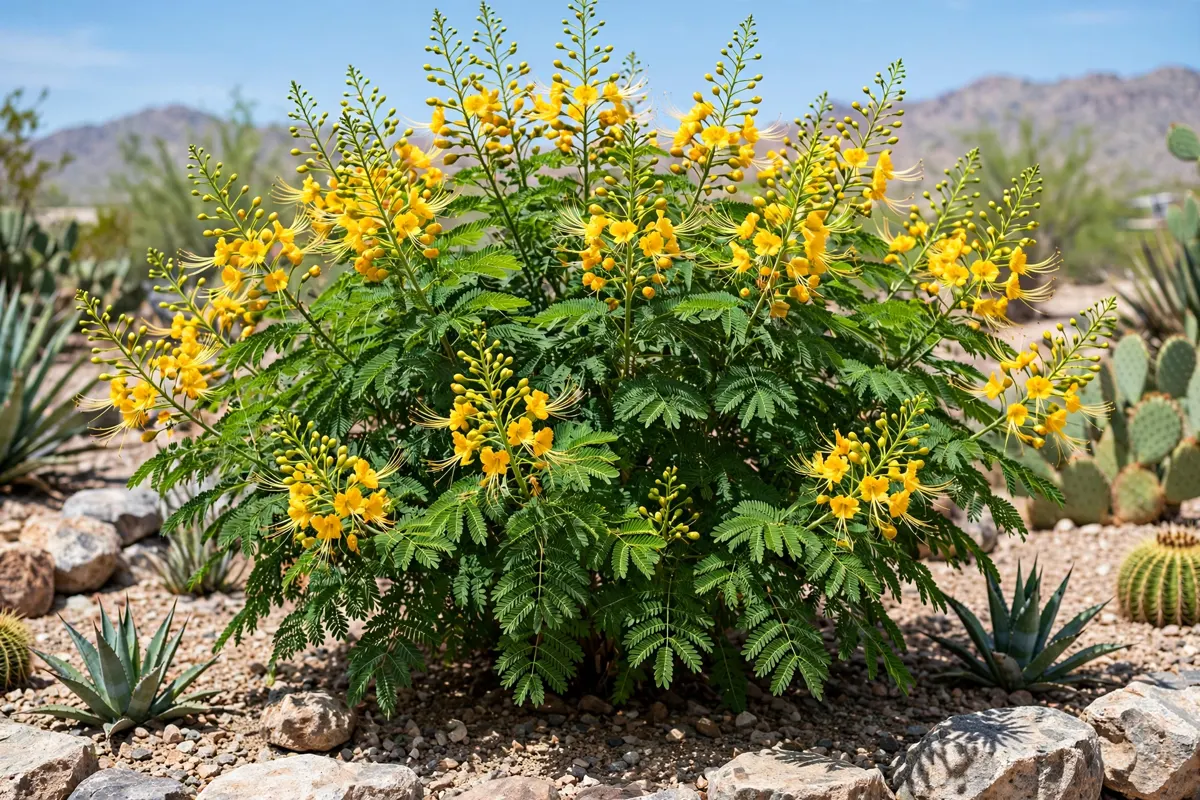
Mexican bird of paradise is a fast-growing, sun-loving evergreen shrub or small tree, botanically known as Caesalpinia mexicana and now also classified as Erythrostemon mexicanus, which produces clusters of bright yellow flowers through the warm months and thrives in full sun, well-drained soil and hot, dry conditions. As of November 2026, the University of Florida IFAS Extension lists it as suited to USDA hardiness zones 9A through 11B, with high drought tolerance once established, a mature height of at least fifteen feet, and a preference for full sun, although it will tolerate partial shade with fewer flowers. It is not the same plant as the common bird of paradise, Strelitzia, and it is a legume, which means its roots fix nitrogen from the air, so it needs little fertiliser and grows well in poor soil where many other flowering shrubs struggle.
Gardeners choose this plant for a simple reason, which is that it gives a tropical-looking display of yellow flowers for months at a time while asking for very little in return, and that combination is rare among shrubs that flower so freely. It suits desert and Mediterranean-style gardens, sunny borders, large containers and parking strips, and it can be trained as a small multi-stemmed tree or kept as a broad, rounded shrub, depending on the space available. The rest of this guide explains how to tell it apart from its lookalikes, where to plant it, how to water and prune it, and the safety points that matter if you have children or pets, so that you can enjoy its flowers without any unpleasant surprises.
What Is Mexican Bird of Paradise?
Mexican bird of paradise is an evergreen large shrub to small tree that is native to the southernmost parts of Texas and central Mexico, where it grows naturally in scrub and dry tropical forest, and that origin explains almost everything about how it behaves in a garden. The University of Florida IFAS Extension describes it as having a rounded growth habit, reaching a minimum height of fifteen feet with a spread of ten feet or more, and producing its most abundant flowers in full sun, although it can also grow in partial shade. Its leaves are finely divided and feathery, dark green in colour, and arranged in a bipinnate pattern that gives the shrub a soft, fern-like texture even when it is not in flower, which is part of its appeal as a foliage plant as well as a flowering one.
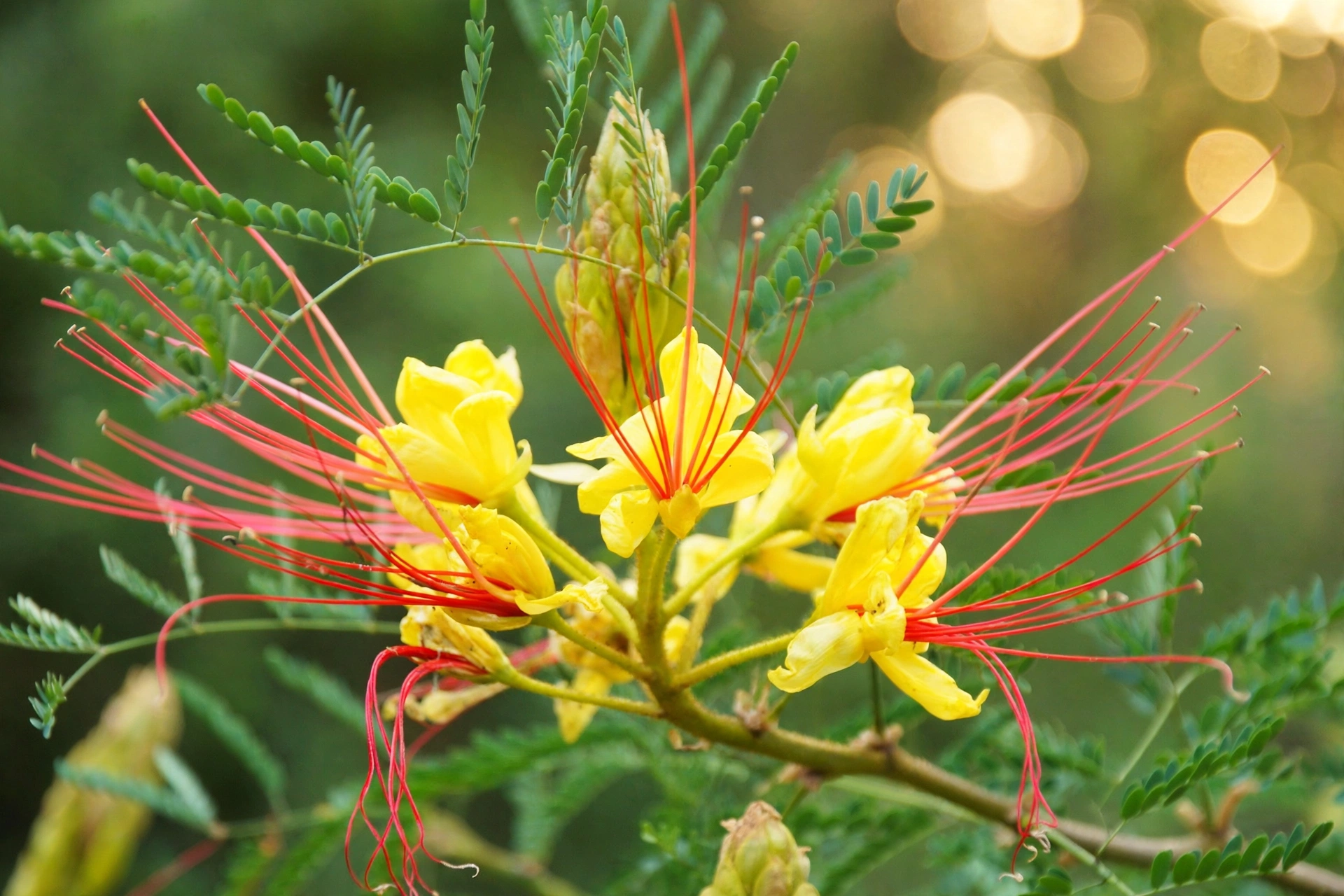
The flowers are the reason most gardeners plant it, because they appear in clusters on the new growth, are a clear, warm yellow, and resemble small azalea-like blooms that cover the canopy for several months during the warm season, attracting bees and other pollinators. The plant grows quickly where winters are mild, it is adapted to low-rainfall climates from southern California through Texas and into Mexico, and it thrives in regions without hard freezes, although it can regrow from its roots if a light freeze damages the top growth. That resilience, combined with its nitrogen-fixing roots, which allow it to grow in poor soil, makes it a forgiving choice for a sunny, dry garden, provided it is given the drainage and the sunlight it needs from the start.
Mexican Bird of Paradise vs Common Bird of Paradise: How to Tell Them Apart
The confusion between these two plants is understandable, because they share a common name, yet they belong to different families, look quite different, and need different conditions, so telling them apart before you buy is worth a few minutes of attention. The common bird of paradise, Strelitzia reginae, is the familiar houseplant and garden plant with large, banana-like leaves and striking orange and blue flowers that resemble a bird in flight, and it prefers moist, rich soil and regular watering, while the Mexican bird of paradise has fine, feathery, bipinnate leaves, clusters of yellow flowers, and seed pods that reveal its membership of the legume family. If the plant in front of you has broad, paddle-shaped leaves, it is a Strelitzia, and if it has delicate, fern-like foliage and yellow flower spikes, it is almost certainly a Caesalpinia or Erythrostemon species.
The distinction matters because the care advice for the two plants is almost opposite in places, and a gardener who waters a Mexican bird of paradise as if it were a Strelitzia is likely to cause root rot, while a gardener who treats a Strelitzia as a desert plant will watch it struggle and fail to flower. This shrub tolerates drought, heat and poor, well-drained soil, and it resents wet feet and heavy nitrogen fertiliser, whereas the common bird of paradise appreciates humidity, regular watering and richer soil. Checking the botanical name on the label is therefore the simplest safeguard, because a label that reads Caesalpinia mexicana or Erythrostemon mexicanus confirms that you are buying the yellow-flowered, drought-tolerant shrub described in this guide, and not its better-known, moisture-loving namesake.
Where and When to Plant This Sun-Loving Shrub
The best place for Mexican bird of paradise is the sunniest, warmest spot in your garden, with well-drained soil and enough room for a shrub that can reach ten to fifteen feet high and wide, because a plant that is squeezed into shade or a damp corner will grow leggy, flower poorly and become more vulnerable to cold damage. The University of Arizona Campus Arboretum notes that it should be located in full sun, in well-drained soil with a pH range of 5.6 to 7.8, which covers acidic to slightly alkaline conditions, and that it is suited to USDA hardiness zones 9 to 11, with the University of Florida IFAS Extension giving the more precise range of zones 9A through 11B. In those zones it can be planted year-round, while in colder regions it is best grown in a large container that can be moved to shelter before the first frost, or treated as a seasonal feature that may lose its leaves or die back in winter.
Spacing matters as much as sunlight, because the University of Florida IFAS Extension recommends planting on ten- to fifteen-foot centres, which reflects the mature spread of the shrub and prevents the overcrowding that leads to poor air circulation and fewer flowers. A site near a patio, a sunny wall or a south-facing border works well, because the reflected heat encourages flowering, and the shrub’s fine foliage provides light shade without creating the dense gloom of a larger tree. Before planting, dig a hole that is wider than the root ball, check that water drains away freely rather than pooling, and avoid planting it in a low spot where cold air and water collect, because good drainage and good air movement are the two conditions that this plant values most after sunshine itself.
How to Care for It Through the Seasons
Caring for this shrub through the seasons is largely a matter of giving it sun, drainage and restraint, because it is a low-maintenance plant that suffers more from over-attention than from neglect. During the growing season in spring and summer, it flowers most freely in full sun and benefits from a deep watering about once a month once established, although watering more often can improve flowering, provided the soil is allowed to dry between waterings and never stays soggy. Young plants need more regular moisture while their roots establish, and they should be kept moist, but not waterlogged, through their first hot summer, after which their drought tolerance increases markedly and they can survive on very little supplementary water in a dry climate.
In autumn, the shrub continues to flower while the weather stays warm, and its growth slows as temperatures fall, which is the time to stop fertilising and to reduce watering so that the plant hardens off before winter. In regions with freezing winter temperatures, the University of Arizona Campus Arboretum advises covering the root area with organic mulch before freezes are expected, because the plant may resprout from its roots if the top growth is frozen, and a mulch layer protects those roots through the coldest nights. In USDA zones 9 to 11 it usually remains evergreen, and The Spruce notes that it can remain evergreen down to about fifteen degrees Fahrenheit, although colder weather will cause leaf loss, and any winter damage should be left until after the last frost before it is pruned away, so that the plant is not encouraged into tender new growth that a late frost could destroy.
Pruning, Feeding and Watering: Getting the Balance Right
Pruning, feeding and watering are the three areas where gardeners most often go wrong with this plant, and the common thread is that less is usually more, because Mexican bird of paradise responds poorly to heavy pruning and to rich feeding. The University of Arizona Campus Arboretum advises pruning only lightly, if at all, to remove winter damage after the last frost, and the plant can be trained into a small tree by removing lower foliage and branches, or left to develop its natural rounded form with branches drooping toward the ground where there is enough room for it to spread. Heavy or repeated pruning will reduce flowering, because the flowers are borne on new growth, and a shrub that is cut back hard will spend its energy regrowing foliage rather than producing the yellow flower clusters that make it worth growing.
Feeding follows the same restrained logic, because the plant’s roots contain nitrogen-fixing nodules, which host beneficial bacteria that convert atmospheric nitrogen into a form the plant can use, and for that reason the University of Arizona Campus Arboretum advises avoiding nitrogen fertiliser altogether. If feeding is needed at all, a no-nitrogen formula such as 0-10-10 during the growing months is the appropriate choice, as recommended in The Spruce care guide, and it should be applied sparingly rather than as a routine dose. Watering should follow the same pattern, with deep, infrequent watering that encourages deep roots, a check that the top few inches of soil are dry before watering again, and a recognition that an established plant in a dry climate may need no supplementary watering at all, which is a rare and welcome trait in a shrub that flowers as freely as this one.
Is It Toxic or Invasive? What Gardeners Should Know
This shrub is a plant that deserves respect as well as admiration, because its seeds and seed pods are toxic if ingested, and the University of Florida IFAS Extension states that the seed pods and seeds display toxic characteristics and can cause gastrointestinal distress if eaten. The University of Arizona Campus Arboretum adds that the seeds are poisonous, and that the plant is toxic if ingested by cats, rabbits or dogs, so it should be planted with care where young children or pets may be tempted to pick up the pods. The practical precautions are straightforward, which is to collect and dispose of fallen seed pods, to wash hands after handling the plant, and to site it away from a children’s play area or a vegetable garden, where its pods could be mistaken for something edible.
On the question of invasiveness, the evidence is reassuring, because the University of Florida IFAS Extension does not class the plant as invasive, and it is generally described as a well-behaved garden shrub rather than a self-seeding problem, although it can self-sow lightly in warm climates where conditions suit it. Gardeners who wish to be cautious can remove the seed pods before they split, which also keeps the garden tidier and reduces any risk to children and pets, and they should avoid planting it where it could escape into a sensitive natural area. With those simple precautions, the plant’s reputation as a hardy, fairly low-maintenance shrub is well earned, and it can be enjoyed for many years without the worry that it will take over the garden or harm the people and animals who share it.
Conclusion
This shrub is one of those rare garden plants that asks for very little and gives a great deal in return, because it needs only full sun, well-drained soil and a light hand with water and fertiliser to produce months of bright yellow flowers and soft, feathery foliage. Its origins in the dry scrub and tropical forests of Texas and Mexico have made it tough, drought-tolerant and content in poor soil, and its nitrogen-fixing roots mean that it improves the ground it grows in rather than exhausting it. The key decisions are the ones made before planting, which are to choose a sunny, well-drained site with room to grow, to confirm the botanical name so that it is not confused with the common bird of paradise, and to site it thoughtfully if children or pets use the garden.
Once those decisions are made, the ongoing care is simple, and the reward is a shrub that flowers through the warm months, attracts pollinators, and brings a warm, desert-garden character to a sunny border or patio. Mexican bird of paradise is not a plant for a shady, damp or frost-prone garden, but in the right place it is a reliable, beautiful and genuinely low-maintenance choice, and a gardener who plants it well in November 2026, with the knowledge in this guide, can look forward to a display that returns year after year with very little effort.
Can it grow in the UK?
This shrub is a warm-climate plant suited to USDA hardiness zones 9A through 11B, according to the University of Florida IFAS Extension, which means that most of the United Kingdom is too cold for it to survive outdoors through winter. It can remain evergreen down to about fifteen degrees Fahrenheit, yet a hard British frost is likely to damage or kill the top growth, although the plant may resprout from its roots if the freeze is light and the roots are protected with mulch. The realistic way to grow it in the UK is therefore in a large container that can be moved into a frost-free greenhouse, conservatory or bright indoor space before the first frost, and returned outdoors only once the risk of frost has passed in spring.
That approach allows a UK gardener to enjoy its yellow flowers through the summer, while accepting that it will never become the large, permanent shrub that it becomes in Texas, Arizona or southern California, where winters are mild enough for it to grow outdoors all year round.
How often should I water it?
Once established, this shrub is highly drought-tolerant and may need no supplementary watering at all in a dry climate, although a deep watering about once a month during the growing season is usually sufficient and can improve flowering. The Spruce care guide advises checking that the top few inches of soil are dry before watering, and watering deeply but infrequently, rather than giving the plant frequent shallow drinks that encourage shallow roots and increase the risk of root rot. Young plants are the exception, because they need regular moisture while their roots establish, and they should be kept moist, but not waterlogged, through their first hot summer.
The most common watering mistake is to treat this plant like a moisture-loving shrub, because it comes from dry scrub habitat and its roots are adapted to soil that drains freely and dries out between rains. If the leaves yellow, the soil stays wet for days after watering, or the plant looks unhappy despite regular watering, the cause is more likely to be too much water than too little, and the remedy is to improve drainage, reduce the frequency of watering, and allow the soil to dry thoroughly between waterings.
When does it flower?
This shrub flowers through the warm months, with the University of Florida IFAS Extension noting that its flowers cover the canopy for several months during the warm season, and that they are borne on new growth in clusters of bright yellow blooms. In its native range and in warm gardens, flowering can begin in spring and continue through summer and into autumn while temperatures remain high, with the heaviest display occurring in full sun and after a period of warm, dry weather. The exact timing depends on the local climate, because a plant in southern Texas will flower earlier and longer than one in a cooler or more northerly garden, where the season is shorter.
A light application of a no-nitrogen fertiliser such as 0-10-10 during the growing months can help, but the most important factor is sunlight, and a plant grown in partial shade will flower noticeably less than one grown in full sun, so site it carefully.
Is it poisonous to dogs and cats?
Yes, this shrub is toxic if ingested, and the University of Arizona Campus Arboretum states that its seeds are poisonous and that the plant is toxic if ingested by cats, rabbits or dogs. The University of Florida IFAS Extension adds that the seed pods and seeds display toxic characteristics and can cause gastrointestinal distress if ingested, which means that a pet that chews or eats the pods may become unwell. The risk is greatest where fallen pods are left on the ground, because a curious dog or cat may pick them up and chew them, and young children may do the same.
The practical response is to collect fallen pods promptly, to site the plant away from areas where pets play or children are likely to pick things up, and to wash hands after handling the plant or its seed pods. If a child or a pet is thought to have eaten any part of the plant, veterinary or medical advice should be sought promptly, and the plant should be identified by its botanical name, Caesalpinia mexicana or Erythrostemon mexicanus, so that the advice given is accurate for this particular species.
How big does it get?
This shrub is a fast-growing shrub that can reach ten to fifteen feet high and wide where winter temperatures allow, according to the University of Arizona Campus Arboretum, while the University of Florida IFAS Extension gives a minimum height of fifteen feet with a spread of ten feet, and other sources describe plants reaching fifteen to twenty-five feet in ideal conditions. The eventual size depends on the climate, the soil and whether the plant is pruned, because a plant in a warm, sunny garden with room to grow will become considerably larger than one grown in a container or in a cooler climate where winter dieback limits its growth each year. Its growth rate is generally described as fast, which means that it can fill its allotted space within a few seasons.
That size should be planned for at planting time, because a shrub that is planted too close to a house, a path or another plant will need regular pruning to keep it in bounds, and heavy pruning reduces flowering. Planting on ten- to fifteen-foot centres, as recommended by the University of Florida IFAS Extension, gives the shrub room to develop its natural rounded form, and training it as a small tree by removing lower branches is an option where a more open, tree-like shape is preferred.