
Emergency Roof Repair Near Me: What to Do Right Now, What It Costs, and How to Find Help Fast
Emergency roof repair near me is the search every homeowner makes when water is coming through the ceiling or a storm has torn part of the roof away, and the first hour matters more than most people realise. Start inside the house, not on the roof: move furniture and electronics out of the drip zone, put buckets under leaks, switch off power to any circuit where water is near a light fitting or socket, and photograph everything before you clean up. Then call a local roofer who offers same-day or 24-hour call-outs, because a professional emergency tarp, which typically costs around 200 to 600 dollars for a single slope, can protect the house for weeks while a permanent repair is scheduled. Do not climb onto a wet or damaged roof yourself, and call your insurer the same day if a storm, falling tree or high wind caused the damage.
What Counts as a Roofing Emergency
A roofing emergency is any damage that lets water into the home, threatens the structure, or creates an immediate safety risk, and it needs same-day attention rather than a routine appointment next week. Active leaks through the ceiling, missing or torn-off sections of shingles after high wind, a tree limb that has punched through the decking, and bent or torn flashing around a chimney, skylight or vent all qualify, because each one leaves the inside of the house exposed to the next rainfall. A ceiling that is sagging or bulging with trapped water is also an emergency, since the plasterboard can collapse without warning and bring down litres of dirty water. Small issues such as a single lifted shingle with no leak, a blocked gutter, or moss growth can usually wait for a normal booking, but anything involving water inside the living space should be treated as urgent.
The damage is often worse than it looks from the ground, because water travels along timbers and insulation before it appears as a stain on a ceiling some distance from the actual hole. That is why a professional inspection matters even when the visible damage seems small, and why photographs taken from the ground, in the attic and inside the rooms are so valuable for both the roofer and any insurance claim. After any storm or high-wind event, check for missing, cracked or lifted shingles, granules collecting in the gutters or at the downspouts, fresh water stains spreading across a ceiling, and branches or debris sitting on the roofline. If any of these signs appear, do not wait for the problem to spread, because a small leak can soak insulation, stain ceilings, damage wiring and encourage mould within days.
What to Do in the First Hour
The first hour after discovering a roof leak is about limiting damage inside the house while help is on the way, and the steps are simple enough for anyone to follow safely from the ground floor. Move furniture, electronics, rugs and valuables out of the drip zone, lay down buckets, bowls and towels to catch water, and place a bucket under any ceiling that is bulging with trapped water before poking a small hole at its lowest point with a screwdriver, so the water drains in a controlled way instead of bringing the ceiling down. If water is anywhere near a light fitting, socket or ceiling fan, switch that circuit off at the breaker and keep people out of the room until an electrician or roofer has checked it. Photograph and video everything first, including the interior stains, the attic, wet insulation and damaged belongings, and the roof itself from the ground, because those images are the foundation of an insurance claim.
Once the inside is contained, the next call should be to a roofer, and ideally before the insurer, because a documented professional inspection makes the claim conversation far shorter and stronger. Tell the roofer exactly what happened, whether water is still coming in, and whether the roof is safe to access, then ask whether they offer after-hours tarping, what the call-out costs, and whether that fee is credited against the permanent repair. Keep every receipt for buckets, sheeting, tarps and any emergency work, because insurers generally expect homeowners to take reasonable steps to stop further damage, and emergency tarping and board-up are routinely reimbursed as part of a storm claim. Do not sign anything handed to you by a door-to-door contractor in that first hour, and do not let anyone onto the roof until you have checked who they are.
Why You Should Not Climb Onto the Roof Yourself
Climbing onto a wet, damaged roof is one of the most dangerous things a homeowner can do in an emergency, and it is a risk that professional roofers train and equip themselves to manage. A roof that has lost shingles or decking may have soft or missing sections that give way underfoot, wet surfaces are extremely slippery, and wind, rain, darkness or ice multiply the danger, while a fall from a typical two-storey roof edge can cause life-changing injuries. Safety rules in the United States require fall protection for workers exposed to falls of six feet or more above a lower level, a threshold that most residential roof edges exceed by a wide margin, which is a useful reminder that even professionals treat roof work as high-risk.
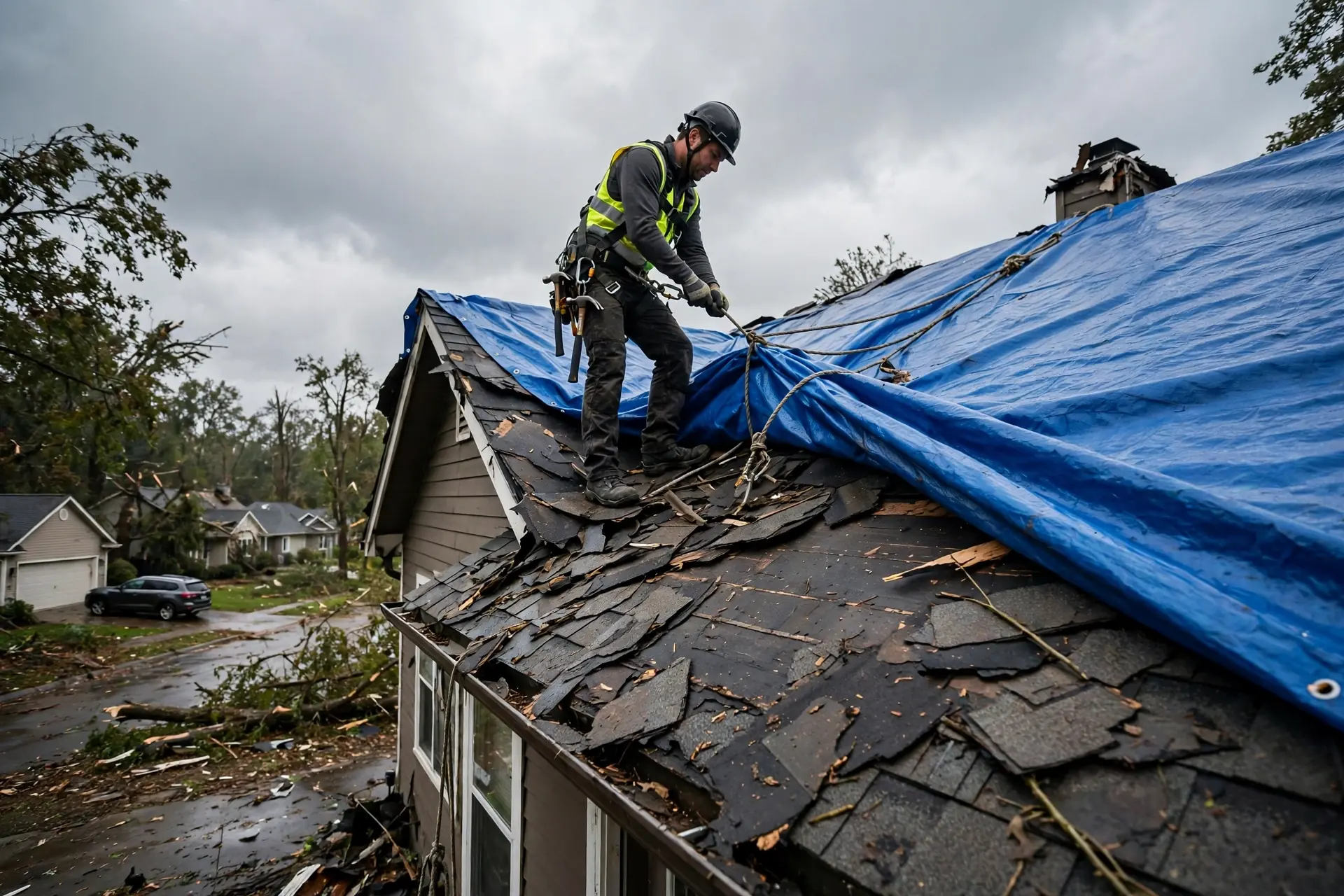
There is also a practical reason to stay off the roof, which is that an untrained repair often makes the damage worse and can complicate an insurance claim. Walking on damaged shingles can crack more of them, nailing a tarp in the wrong place can create new holes, and a poorly placed cover can funnel water into the house instead of away from it. A professional crew knows how to run a heavy tarp past the damaged area and ideally over the ridge, securing it with battens so that wind cannot lift it, and they will photograph the damage properly for the claim file. If you can safely reach a low, dry section of roof from a ladder, a temporary cover may be possible, but in rain, wind or darkness the correct decision is to stay inside, contain the water, and wait for the crew.
How Emergency Roof Tarping Works
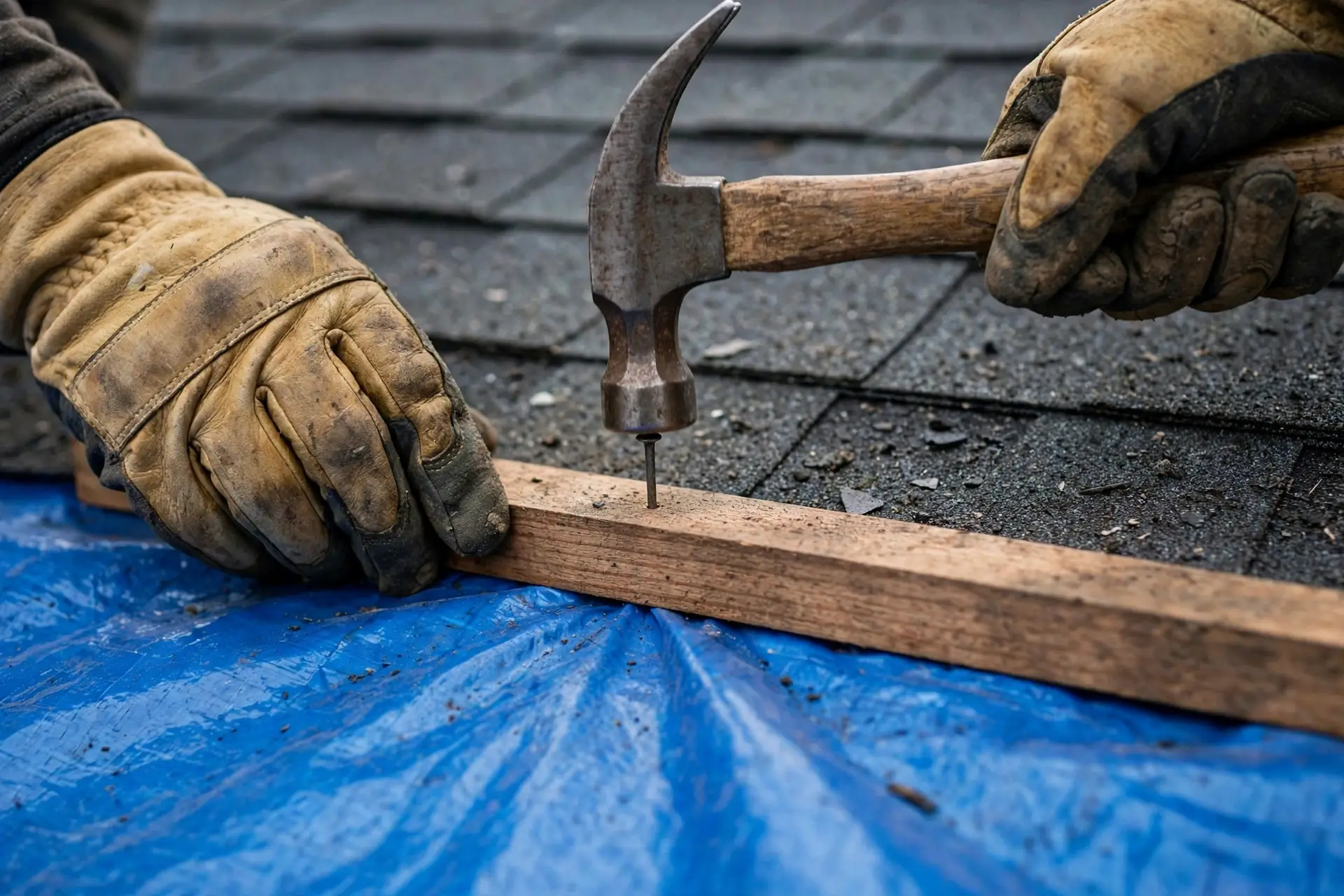
Emergency roof tarping is a temporary cover placed over the damaged section of a roof to block rain and wind until permanent repairs can begin, and it is the single most common emergency service roofers provide. A crew lays a heavy-duty waterproof tarp over the affected area, running it past the damage and ideally over the ridge so water sheds away from the hole, then fixes it in place with timber battens screwed through the tarp into sound decking. The tarp buys time rather than fixing the underlying damage, which is why a follow-up visit for permanent work is always part of the plan, and a properly installed tarp can protect the house for weeks while materials are ordered and a repair slot is scheduled. It is stabilisation, not a repair, and any contractor who describes a tarp as a permanent solution should be treated with suspicion.
The cost of tarping depends mainly on the size of the damaged area, the time of day and how quickly the crew must respond. Planning ranges published for 2026 put a single-slope emergency tarp at roughly 200 to 600 dollars, or about 1 to 2.80 dollars per square foot including the visit, debris removal, photographs for insurance and a repair estimate, with after-hours or weekend work adding roughly 150 to 450 dollars to the call-out. A small patch over a few missing shingles may cost 170 to 470 dollars all in, while a large torn-off section of around 400 square feet can run from 780 to 2,200 dollars for the tarp alone. These are guide ranges that vary by region, roof pitch and access, so always ask for a written figure before the crew starts, and confirm whether the tarping fee is credited if the same company carries out the permanent repair.
How Much Does Emergency Roof Repair Cost in 2026
Emergency work is priced for the response as much as for the materials, which is why the same repair can cost far more at 2 a.m. on a Sunday than it would on a quiet Tuesday morning. The table below gives 2026 planning ranges for asphalt shingle roofs in the United States, drawn from published contractor guides, and local prices will vary with region, roof pitch, access and the time of the call-out, so treat these as a budgeting guide and always get a written quote before work starts.
| Repair | Typical 2026 guide range |
|---|---|
| Emergency tarp, single slope | $200–$600 |
| After-hours or weekend call-out fee | $150–$450 on top of the repair |
| Temporary shingle or flashing patch | $300–$950 |
| Board-up of a punctured deck | $350–$1,200 |
| Interior water mitigation and drying | $500–$3,000 |
| Permanent repair after the emergency | $400–$3,500 |
| Minor leak repair | $300–$800 |
| Severe structural damage | $4,000–$15,000+ |
Roofers typically add around 200 to 300 dollars for an unscheduled call and charge time-and-a-half for 24-hour emergency service, according to 2026 pricing guides, so a small repair that would cost 150 to 300 dollars in a regular slot can run 350 to 600 dollars the same day and 400 to 690 dollars at night. Larger damage scales in the same way: a repair covering around 100 square feet might cost 350 to 1,000 dollars in a normal booking, 550 to 1,300 dollars the same day, and 660 to 1,600 dollars for a night call-out. The lesson is that speed costs money, and that a tarp plus a scheduled permanent repair is usually cheaper than demanding a full repair in the middle of the night, unless water is still pouring in and there is no safe way to contain it until morning.
Will Insurance Pay for Emergency Roof Repair
Most standard homeowners insurance policies cover roof damage caused by a sudden event such as wind, hail, a falling tree or fire, and emergency tarping and board-up are usually reimbursed because the policy contains a duty to mitigate further damage. That duty means the homeowner is expected to take reasonable steps to stop the damage getting worse after a covered event, so calling a roofer for a tarp, photographing everything, and keeping every receipt is not just sensible housekeeping but part of meeting the policy terms. Hail damage is included in the standard homeowners policies of most companies, and wind and falling-tree damage are similarly covered in most cases, although the exact wording, the excess and any exclusions for wear and tear or poor maintenance vary by policy and by insurer. Damage that has built up slowly, such as a leak from an ageing roof that was never maintained, is far less likely to be covered, which is another reason regular inspections matter.
To give a claim the best chance, report the damage to the insurer the same day, describe what happened and when, and ask directly what the policy reimburses for temporary repairs before the adjuster visits. Do not start permanent repairs before the adjuster has seen the damage unless the roofer advises that delay would cause serious further harm, because the insurer needs to inspect the loss as it stands. Be wary of any contractor who offers to waive your excess or deductible, since deductible-waiving offers are insurance fraud in several US states and a contractor who suggests it is advertising dishonesty. Get the roofer’s written scope and photographs, keep the insurer’s claim number safe, and remember that the adjuster’s decision is based on the policy wording and the documented evidence, so thorough photographs and a clear timeline are worth more than any amount of arguing.
How to Find Emergency Roof Repair Near Me
When water is coming in, the fastest reliable way to find emergency roof repair near me is to search for local roofers who advertise 24-hour or same-day call-outs, then call two or three of them directly rather than filling in web forms and waiting for a reply. Ask each one the same questions: do you tarp after hours, what is the call-out fee, how soon can a crew reach me, is the tarping fee credited against the permanent repair, and are you licensed and insured in this area. A genuine local company will answer clearly, give a street address rather than a post office box, and be able to send a written quote, while a company that pressures you to sign immediately, demands full payment upfront, or cannot name a local address should be avoided. Check reviews on Google or an established review platform while you wait, and prefer a roofer with a local landline, a branded vehicle and a history of work in your area.
The days after a big storm bring a second hazard in the form of storm-chaser contractors, who arrive from out of state, knock on doors, and offer quick cheap repairs before disappearing. The warning signs are an out-of-state number plate, no local address, pressure to sign on the spot, a request for cash or a large deposit upfront, and a promise to handle the whole insurance claim for you. A trustworthy roofer will inspect the damage, explain the options, give a written scope with a price, and let you contact the insurer yourself, and they will still be reachable in six months if the repair fails. If a door-knocker cannot provide a written scope, proof of insurance and a local address, send them away and call a company you found yourself, because a bad emergency repair can cost far more to fix than the original damage.
When a Repair Is Not Enough
Sometimes the honest answer from a roofer is that the roof is beyond a patch, and recognising that early saves money and repeated leaks. If the roof is over twenty years old and has already needed several repairs, if shingles are curling, cracking or losing granules across large areas, if the decking is soft or sagging, or if leaks keep appearing in new places after each fix, a full replacement is usually better value than another emergency patch. A roofer should be able to show you photographs of the decking and explain why a repair will not hold, and a second opinion is worth getting before committing to a replacement that can cost many thousands. Regular maintenance, including clearing gutters, replacing cracked flashing and inspecting the roof each autumn, prevents most emergencies entirely, because the majority of sudden leaks start as small defects that were visible months earlier. An annual inspection costs far less than one night-time call-out, and it is the cheapest form of emergency roof repair there is.
How Fast Can Emergency Roof Repair Near Me Arrive
A local roofer offering a genuine 24-hour service can usually reach a home within a few hours, and often within one to two hours in a town or city, although response times stretch considerably during a major storm when every roofer in the area is busy. Tarping crews prioritise homes with active water coming in and structural damage, so describe the situation accurately when you call, including whether water is still entering and whether the ceiling is sagging. If the first company cannot come until tomorrow, call a second and a third, and ask each one whether they can at least tarp the roof tonight and schedule the permanent repair later. Keep containing the water inside while you wait, and do not accept a promise of a visit with no time attached when water is still pouring in.
What Should I Do If My Roof Is Leaking Right Now
If your roof is leaking right now, contain the water with buckets, move furniture and electronics away from the drip, switch off power to the affected area if water is near a light fitting or socket, and photograph everything before you clean up. If the ceiling is bulging, put a bucket underneath and poke a small hole at its lowest point with a screwdriver so it drains in one place instead of bringing the plasterboard down. Do not climb onto the roof in rain, wind, darkness or ice, because a fall is a far bigger emergency than a leak and the tarp can wait until it is dry. Then call a local roofer for emergency tarping and call your insurer the same day, keeping every receipt for the temporary work and the photographs you took at the start.
Does Homeowners Insurance Cover a Leaking Roof
Homeowners insurance usually covers a leaking roof when the leak was caused by a sudden covered event such as wind, hail or a falling tree, and it usually pays for emergency tarping as part of mitigating further damage. It does not usually cover leaks caused by gradual wear, age or poor maintenance, so a twenty-year-old roof that has never been inspected is unlikely to be covered for a slow leak. Check the policy wording for the excess, any exclusions and the duty to mitigate, report the damage the same day, and keep photographs and receipts for everything. If the insurer disputes the claim, the roofer’s written inspection report and dated photographs are the evidence that matters most, so make sure both exist before any permanent repair begins.
Conclusion
Emergency roof repair near me is a search nobody wants to make, but the homeowners who come through it best are the ones who act inside the house first, call a local roofer quickly, and document everything for the insurer. Contain the water, switch off any threatened electrics, photograph the damage, get a professional tarp in place, and let the permanent repair follow in daylight with a written quote and a proper inspection. Expect to pay a premium for speed, with a single-slope tarp typically costing around 200 to 600 dollars and night call-outs adding more, and be wary of door-knockers and deductible-waiving offers that appear after every storm. Keep the number of a trusted local roofer saved before the next storm season, inspect the roof once a year, and the next emergency will be a phone call and a tarp rather than a crisis.