
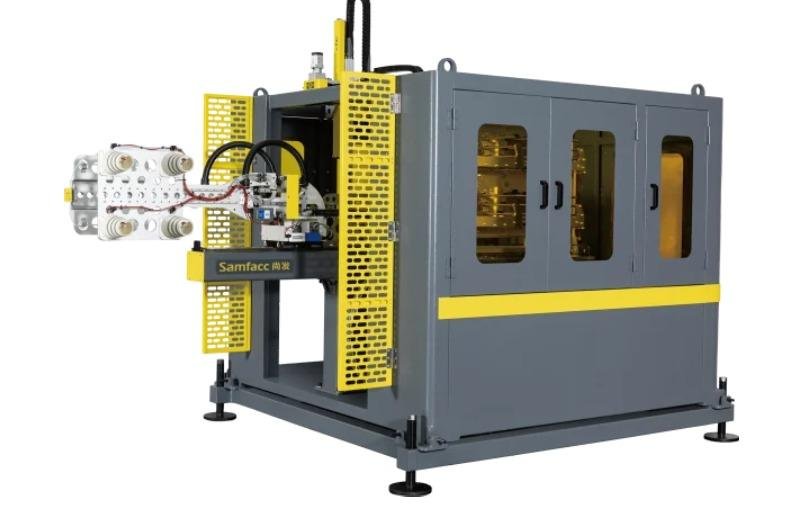
A glossy spec sheet tells you very little about how an in-mold labeling cell will perform on your mold, with your labels, at your cycle time. Experienced molders learn to ask a short list of pointed questions before they compare prices. These are the eight that matter most, with the published industry reference points that help you judge the answers.
1. What mold-open time does my product really allow?
Start with the process, not the robot. In an IML cycle the mold opens, labels go in, finished parts come out, and the mold closes again. Wittmann told Moldmaking Technology that cycle time has the biggest influence on robot selection, and that typical IML cycles are five seconds or less. Absolute Robot has described quoting systems for mold-open times as short as 1.8 seconds. Give any supplier your actual number and ask them to show how their motion profile fits inside it.
2. Is a side-entry or top-entry layout right for my press?
Absolute Robot’s rule of thumb is that 100 to 300 ton presses generally use side-entry automation, while 400 to 500 ton machines need top-entry. Stack molds usually require two or more independent side-entry robots, according to Wittmann. Ask the supplier to explain the layout choice for your press, not a generic one.
3. How many labels per cycle, and at what size?
Cavity count drives the end-of-arm tool design. A workcell described by Packaging World places labels eight at a time. One older PlasticsToday equipment review noted a system handling labels up to 8 by 8 inches. Make sure the supplier has handled your cavity count and label size, and ask for a reference.
4. How is placement accuracy measured?
This one trips up many buyers. Published figures vary widely: Samfacc states a placement deviation under ±0.02 mm, while the Packaging World case cites 0.02 inches, which is roughly 0.5 mm. The numbers may well describe different things. Ask whether the figure is repeatability or absolute accuracy, at what cavity count it was measured, and under what conditions.
5. How are labels held and released?
Film can be difficult to hold flat, and static electricity is a common solution. The PlasticsToday system used an electrostatic charger on the tooling, and Samfacc lists suction cups, electrostatic pads and grippers as interchangeable options. Ask which method suits your film and surface finish, and what happens when humidity changes.
6. How long does a changeover take?
If you run many short jobs, changeover time can matter as much as cycle time. In the PlasticsToday example, a label change was handled by swapping the magazine and the tooling, and the magazine gave a one-hour production buffer. Samfacc says its modular tooling can be changed within minutes. Ask for a timed demonstration where possible.
7. What checks and protections are built in?
A missing or shifted label produces scrap. The Packaging World workcell checks label presence and position on all eight lids at once. Samfacc lists built-in safety interlocks, real-time monitoring and predictive maintenance alerts for its IML robots. Ask what is standard, what is optional, and what the robot does when a check fails.
8. Who supports it after installation?
When you contact an iml robot manufacturer, ask about spare parts lead times, remote diagnostics, operator training and what happens when your line stops at night. Samfacc’s pages cite a 95 percent customer repurchase rate and a decade of steady growth, which is an unverified company statement worth confirming through customer references. A supplier’s own claims are a starting point; direct conversations with existing users are better evidence.
Putting the answers side by side
Create a simple scorecard with the eight questions as rows and each shortlisted supplier as a column. Score the answer, but also record how specific it was. A vague answer to the accuracy question or the changeover question is itself information.
| Question | What a strong answer sounds like |
| Mold-open time | Names a figure and shows the motion profile |
| Layout | Ties choice to press tonnage and cavities |
| Label size and count | Cites a comparable installation |
| Accuracy | States the measurement method |
| Label holding | Matches method to your film |
| Changeover | Offers a timed demonstration |
| Inspection | Lists what is standard and what is optional |
| Support | Offers references and response times |
Frequently asked questions
Do I need a vision system? Not always. It depends on the cost of a mislabeled part against the cost of inspection. For multi-cavity food containers, many molders consider it worthwhile.
Can one robot do labeling and part removal? Yes. The Packaging World workcell removes the part immediately after molding, and this combined motion is common in side-entry systems.
What label materials do suppliers support? Samfacc lists PP, PS and PET, matched to the molded substrate. Check with your label converter that the film will bond properly with your resin.