
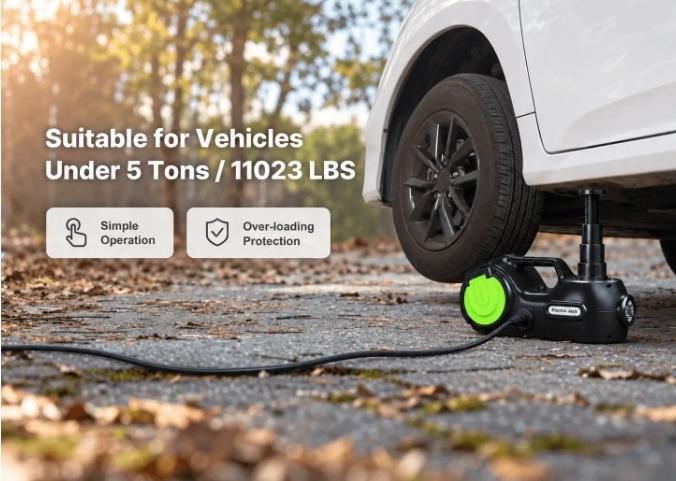
A flat tire on a busy highway shoulder is not just an inconvenience. NHTSA data cited by the AAA Foundation show that more than 2,100 people were killed outside disabled vehicles at the roadside between 2019 and 2023, and the Foundation believes the true figure may be higher. Every minute spent winding a scissor jack by hand is a minute spent beside moving traffic, so the choice of jack matters more than most drivers assume.
Choosing one comes down to three questions: whether it is strong enough, whether it reaches high enough, and whether it can be powered where the problem happens.
Strength: the 75 percent rule and what it implies
Most guidance on jack capacity starts with the vehicle’s gross vehicle weight rating, the GVWR printed on the sticker inside the driver’s door or in the owner’s manual. The rule of thumb that automotive professionals repeat is to choose a jack rated for at least 75 percent of the GVWR, because lifting one end or one corner does not put the full vehicle weight on the jack. Guidance that covers lifting both ends at once calls for a much larger margin, roughly 150 percent.
Turning that into numbers gives a quick lookup:
| Vehicle GVWR | Minimum jack rating at 75 percent |
| 2,000 kg | 1,500 kg |
| 3,000 kg | 2,250 kg |
| 4,000 kg | 3,000 kg |
| 5,000 kg | 3,750 kg |
| 6,000 kg | 4,500 kg |
| 6,667 kg | 5,000 kg |
The last row is the useful one. A jack rated at 5 tonnes passes the 75 percent test for vehicles up to about 6,667 kg GVWR, which comfortably covers passenger cars, SUVs, pickups and many light vans. That makes 5 tonnes a sensible rating for a roadside kit that has to serve more than one vehicle.
Height: the specification people forget
A jack that can carry the load but cannot slide under a low sedan, or cannot reach the jacking point on a raised pickup, is useless in practice. Capacity and lift range are separate figures, and a bargain jack often delivers one without the other. When comparing models, check the minimum height under the vehicle and the maximum height of the lift, and compare both with the jacking points shown in the owner’s manual. An electric hydraulic car jack range that offers several lifting range options, as one 12V 5 tonne model in a current line does, reflects how much ride heights differ between vehicles.
Power: what a 12V socket can really deliver
Many electric jacks plug into the vehicle’s 12V accessory socket. Those sockets are fused, typically at 10 to 15 amps, which works out to roughly 120 to 180 watts. Manufacturer manuals reflect that spread: some state 120 W, others 180 W. At least one carmaker advises using the socket only with the engine running to avoid draining the battery.
This matters for two reasons. A jack or inflator that draws more current than the socket’s fuse allows will blow the fuse and stop work halfway through a lift. And a tool combining a jack with a 150 PSI tire inflator, as one model in the line does, makes sense only if its current draw fits within the circuit. The datasheet should state the rated current. If it does not, ask for it before buying.
A cordless alternative avoids the socket entirely. A 21V cordless model with a rechargeable lithium battery is built for exactly that, trading the fuse limit for a battery that needs to be kept charged.
A short, non-negotiable safety routine
Electric power changes how fast a jack lifts. It changes nothing about where a person’s body should be. Product safety regulators are blunt on this point. Australia’s product safety authority warns that people have been crushed to death or severely injured working under a car supported only by a jack, and lists injuries from amputation to fractures.
- Park on firm, level ground, set the parking brake and chock the wheels that stay on the ground.
- Use the lifting points shown in the owner’s manual, not a convenient bit of bodywork.
- Never exceed the jack’s rated capacity.
- Never let a person or pet remain inside the vehicle during the lift.
- Never put any part of your body under a vehicle supported only by a jack. A hydraulic jack holds load with fluid pressure, while jack stands hold it mechanically.
Quick answers
Is 5 tonnes overkill for a hatchback? It is more than enough, and the extra margin does no harm. The cost is usually weight and bulk, not safety.
Does a faster lift make roadside work safer? It reduces time beside traffic, but the data on roadside deaths do not isolate tire changes, so the benefit is plausible rather than measured. Moving as far from the traffic lane as possible matters more.
What should be in the box? A roadside tool kit and a tire inflator are useful additions, but they are extras. Capacity, lift range and power compatibility come first.
The right jack is the one that fits the vehicle’s weight, reaches its jacking points and works from whatever power source will actually be at hand. Everything else is accessory.