
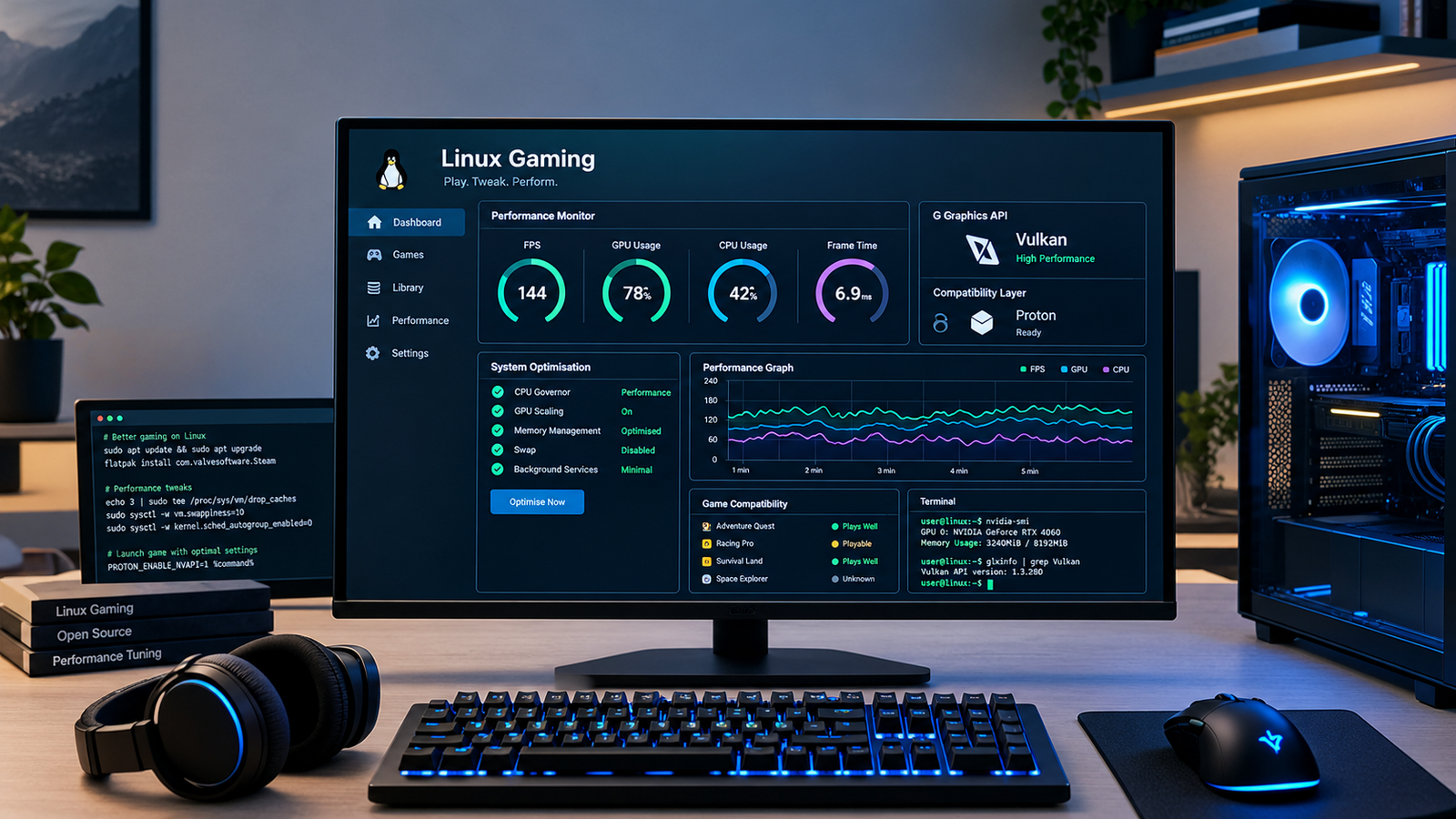
Linux gaming has come a long way, but getting the best experience is not always as simple as installing a game and pressing the Play button. Depending on your hardware, graphics drivers, Linux distribution, game engine and compatibility layer, the same game can behave very differently from one system to another. This is where the idea behind tech hacks pblinuxgaming becomes useful.
Rather than thinking of these hacks as mysterious tricks, it is more accurate to view them as practical Linux gaming adjustments. They can include choosing the right Proton version, keeping graphics drivers updated, monitoring frame times, reducing unnecessary background activity and configuring system resources more effectively. PBLinuxGaming itself presents its material around practical tech hacks, optimisation and performance insights.
The important thing is to make changes methodically. A tweak that helps one computer may make little difference on another, and some aggressive settings can even create instability. Good Linux gaming optimisation is therefore less about applying every possible tweak and more about identifying the actual problem and fixing it with the appropriate tool.
What Does Tech Hacks PBLinuxGaming Actually Mean?
The phrase tech hacks pblinuxgaming can sound as though it refers to a particular piece of software, but the available material generally uses it to describe a collection of Linux gaming techniques rather than one universal application. These techniques focus on performance, compatibility, system configuration and troubleshooting.
That distinction matters because there is no single setting that automatically makes every Linux game faster. Gaming performance depends on several connected layers, including the operating system, CPU, GPU, drivers, rendering API, compatibility software and the game’s own settings. A problem in any one of these areas can affect the final experience.
The original PBLinuxGaming material describes its tech hacks as ways to customise games, adjust graphics and modify settings through files or applications. More recent discussions around the keyword commonly connect it with tools such as Proton, GameMode, MangoHud, Vulkan and other Linux gaming technologies.
Start With Your Linux Gaming Foundation
Before changing advanced settings, make sure the basics are right. Your Linux distribution should be properly updated, your graphics driver should match your GPU, and your system should have enough free storage for games, shader caches and updates. These simple checks can prevent many problems that are incorrectly blamed on Linux gaming itself.
Your graphics driver is particularly important. AMD and Intel systems generally rely heavily on the open-source Mesa graphics stack, while NVIDIA users need to pay close attention to the appropriate NVIDIA driver package. Driver behaviour can vary between distributions and hardware generations, so it is better to use the supported driver for your system rather than installing random packages from unofficial sources.
It is also worth checking whether your game is known to work properly on Linux before spending hours changing system settings. Compatibility information can help you determine whether the problem is likely to be a configuration issue or a limitation involving the game itself. This approach saves time and makes troubleshooting much more logical.
Proton Is One of the Most Important Linux Gaming Tools
For Steam users, Proton is one of the technologies that has dramatically changed the Linux gaming experience. Proton provides a compatibility environment that allows many Windows games to run on Linux without requiring a native Linux version. It builds on technologies such as Wine and integrates components used for graphics translation and Windows compatibility.
Different Proton versions can behave differently with individual games. That means selecting another version can sometimes resolve a launch problem, graphical issue or compatibility problem. However, constantly switching versions without recording what changed can make troubleshooting confusing.
Proton-GE is another option frequently discussed by Linux gaming communities. It is a community-maintained Proton build containing additional patches and changes beyond Valve’s standard Proton releases. It can be useful for particular compatibility situations, but it should not be treated as a guaranteed FPS booster for every game. The correct choice depends on the title, hardware and current compatibility requirements.
Use GameMode for Smarter Resource Management
GameMode is another useful tool in the Linux gaming toolbox. Developed by Feral Interactive, it is designed to allow games and applications to request temporary system-level performance adjustments while they are running.
The idea is straightforward: instead of manually changing several performance settings every time you launch a game, GameMode can coordinate certain adjustments automatically. Depending on your distribution and configuration, this can involve CPU-related settings, process priorities and other system behaviour.
One common Steam launch option is gamemoderun %command%. However, the presence of GameMode does not mean that every game will suddenly gain a dramatic number of frames per second. Its value is more about removing certain system-level bottlenecks and making performance behaviour more consistent when a game is running.
Monitor Performance Instead of Guessing
One of the biggest mistakes in gaming optimisation is changing settings without measuring the result. If your game feels slow, you first need to determine whether the problem is GPU usage, CPU usage, memory pressure, frame-time inconsistency, thermal throttling or something else.
MangoHud is particularly useful here. It can display information such as FPS, frame times, GPU utilisation, CPU utilisation and temperatures while you play. This turns vague complaints such as “the game feels laggy” into something that can be investigated.
Frame rate alone is not the complete story. A game showing a high average FPS can still feel unpleasant if frame times are inconsistent. Monitoring the performance data before and after a change gives you a much better idea of whether a tweak actually helped. If the numbers barely change, there may be little reason to keep the tweak.
Optimise Vulkan, DXVK and Graphics Settings Carefully
Many Windows games running through Linux rely on translation technologies that convert Windows graphics calls into APIs supported by Linux. DXVK is widely used to translate Direct3D 9, 10 and 11 workloads to Vulkan, while VKD3D-Proton handles Direct3D 12 compatibility.
This translation layer is one reason Linux gaming has become more capable, but it also means that your graphics stack matters. Keeping Vulkan components and graphics drivers properly maintained can help avoid compatibility problems and graphical glitches.
Game settings matter just as much. Lowering shadows, reflections, volumetric effects and other expensive graphical features can provide a meaningful performance improvement without making the entire game look poor. If your GPU is the bottleneck, reducing resolution or using an appropriate upscaling technology can also be more effective than changing unrelated operating-system settings.
Reduce Background Processes Before Gaming
Modern Linux desktops can run many services in the background. Cloud synchronisation, browsers with dozens of tabs, update services, recording software and other applications can consume CPU, RAM, storage bandwidth and GPU resources.
You do not need to turn off every background service to optimise a gaming PC. In fact, randomly disabling system processes can create more problems than it solves. Instead, identify applications that are genuinely consuming resources and close unnecessary ones before starting a demanding game.
A clean gaming session is especially useful on systems with limited RAM or older CPUs. If your browser is consuming several gigabytes of memory while a game is trying to load large assets, closing unnecessary tabs may provide a more noticeable improvement than an obscure kernel tweak.
Choose Advanced Tweaks Only When You Need Them
Once the basic setup is working properly, experienced users can explore more advanced areas such as CPU governors, kernel configuration, Gamescope, compositor settings and memory management. These can be useful, but they should be approached carefully.
A custom kernel, for example, can change scheduling behaviour and system responsiveness, but switching kernels is not automatically an upgrade for gaming. Stability, hardware support and workload characteristics all matter. It is sensible to keep a known-working kernel available so you can return to it if an experiment causes problems.
The same principle applies to undervolting, overclocking and aggressive power-management changes. These techniques can be useful for experienced users, but they introduce additional variables. If your primary goal is a stable gaming system, make one change at a time and test it thoroughly before moving to the next.
Network Optimisation Can Help With Online Games
Not every gaming problem is caused by FPS. In multiplayer games, latency and connection stability can be equally important. A computer can display a perfectly smooth frame rate while the player still experiences delayed actions because of network conditions.
Start with simple checks. Use a reliable wired connection where possible, reduce unnecessary downloads while gaming and check whether other devices on your network are consuming significant bandwidth. Wi-Fi interference can also create inconsistent latency, particularly in crowded environments.
Linux users can investigate network behaviour with standard diagnostic tools, but avoid blindly changing TCP parameters or applying random “low-ping” commands found online. Network optimisation is highly dependent on the connection, router, ISP and game server. A measured approach is much safer than applying a collection of unrelated tweaks.
A Simple Tech Hacks PBLinuxGaming Workflow
A good optimisation process should begin with a baseline. Record your game’s average FPS, frame-time behaviour, resolution, graphics settings and relevant hardware temperatures. This gives you something to compare against after making changes.
Next, fix the fundamentals: update the system, verify the correct graphics driver, check the game’s Linux compatibility and select an appropriate Proton version when necessary. After that, tools such as GameMode and MangoHud can help with resource management and performance monitoring.
Only then should you consider advanced tweaks. Change one setting at a time, test the same game scenario and record the result. If performance becomes worse or stability declines, revert the change. This process may sound slower than applying ten tweaks at once, but it produces much more useful information and makes it easier to maintain a stable gaming environment.
Common Mistakes to Avoid With Linux Gaming Tweaks
One common mistake is assuming that every performance guide applies universally. Linux gaming is highly dependent on hardware and software combinations. An optimisation that works on an AMD GPU with one distribution may not provide the same result on an NVIDIA system or another desktop environment.
Another mistake is believing large FPS claims without independent measurements. Performance improvements should be tested against a repeatable scenario rather than accepted simply because a guide promises a percentage increase. Real-world results vary considerably between games and machines.
Finally, avoid changing several variables simultaneously. If you install a new kernel, change Proton, alter GPU settings and modify launch parameters at the same time, you will not know which change affected the result. Good troubleshooting is controlled experimentation, not random tweaking.
Final Thoughts on Tech Hacks PBLinuxGaming
Tech hacks pblinuxgaming is best understood as a practical approach to Linux gaming optimisation rather than a single magic application. The useful part is the underlying idea: understand your system, identify the bottleneck and apply the appropriate tool or configuration change.
For most players, the biggest gains come from getting the fundamentals right. A supported graphics driver, sensible game settings, the appropriate Proton configuration, useful monitoring and sensible resource management can go a long way. Tools such as GameMode, MangoHud, DXVK and VKD3D-Proton each have specific purposes and should be used accordingly.
The most important lesson is to measure before and after every meaningful change. Linux gives gamers a huge amount of control, and that flexibility is one of its biggest strengths. With a careful approach, you can build a gaming setup that is fast, stable and tailored to your own hardware instead of relying on questionable “one-click” performance promises.
You May Also Raed: Stealthgram