

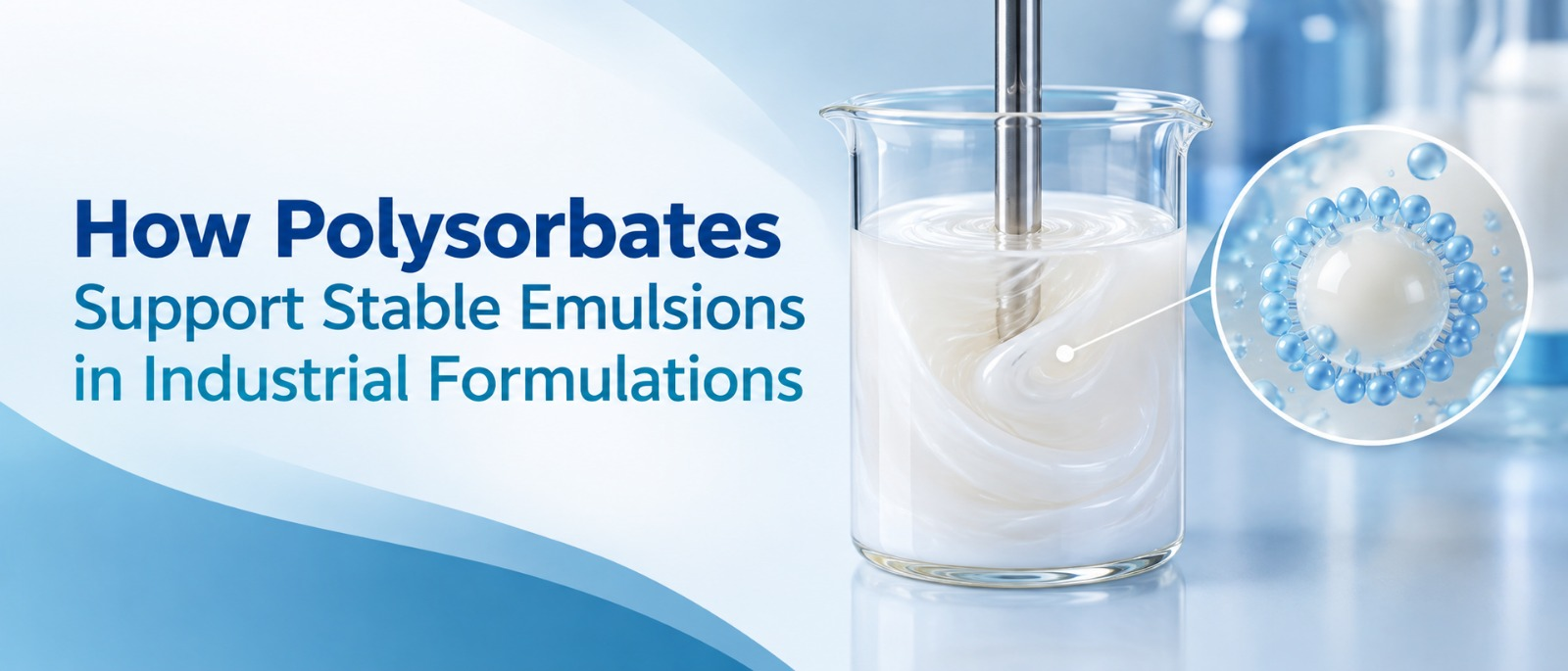
Industrial formulations often combine ingredients that naturally resist mixing, particularly oil-based and water-based components. Without the right emulsification system, these ingredients can separate during storage, transportation, or use. Polysorbates are widely used non-ionic surfactants that help improve compatibility between different phases and support the formation of stable emulsions across a range of industrial applications.
What Are Polysorbates?
Polysorbates are non-ionic surfactants derived from sorbitan esters and ethoxylated compounds. Their amphiphilic structure allows them to interact with both oil and water phases, reducing interfacial tension and helping disperse one phase throughout another.
Different grades of polysorbates offer different hydrophilic-lipophilic balance (HLB) characteristics, making them suitable for specific formulation requirements. Among them, polysorbate 20 is commonly considered when formulators need a water-compatible non ionic surfactant with effective emulsifying and solubilizing properties.
How Do Polysorbates Stabilize Emulsions?
An emulsion contains two immiscible liquids, such as oil and water, with one dispersed as small droplets within the other. These droplets naturally tend to merge, eventually causing phase separation.
Polysorbates can help address this instability through several mechanisms: 1. Reduction of Interfacial Tension
Polysorbates accumulate at the interface between oil and water. By lowering interfacial tension, they make it easier for formulators to create smaller and more uniformly distributed droplets during processing.
Smaller droplets can contribute to improved physical stability when the overall formulation and processing conditions are appropriately designed.
2. Formation of a Protective Interfacial Layer
Once positioned around dispersed droplets, polysorbate molecules can form a stabilizing layer at the oil-water interface. This layer can help reduce the tendency of droplets to come together and coalesce.
This is particularly useful in formulations that need consistent appearance, texture, and performance throughout their intended shelf life.
3. Improved Ingredient Dispersion
In addition to emulsification, polysorbates can assist with the dispersion of certain poorly water-compatible ingredients. This can help formulators achieve more uniform systems and reduce problems associated with uneven distribution.
Why Is Polysorbate 20 Used in Formulations?
Polysorbate 20 is a hydrophilic non-ionic surfactant used in various formulation systems where water compatibility, emulsification, wetting, and solubilization are important.
Its non-ionic nature can make it useful in systems where compatibility with other formulation components is required. However, the appropriate polysorbate grade and concentration depend on factors such as the oil phase, water phase, other surfactants, temperature, processing conditions, and desired emulsion type.
For industrial formulators, selecting the right grade should therefore be based on formulation testing rather than relying on surfactant concentration alone.
Industrial Applications of Polysorbates
Polysorbates can be considered in a variety of industrial and commercial formulation systems, including:
• Personal care and cosmetic formulations
• Industrial cleaners and detergents
• Emulsion-based processing systems
• Coatings and specialty formulations
• Agricultural and chemical formulations
• Fragrance and flavor systems
• Specialty chemical formulations
In each application, the role of a polysorbate can vary depending on the formulation architecture and performance requirements.
Factors to Consider When Selecting Polysorbates
Choosing a polysorbate for an industrial formulation involves more than identifying an emulsifier. Formulators may evaluate:
HLB requirement: The surfactant should be compatible with the required oil-water system.
Concentration: Too little surfactant may provide inadequate stabilization, while excessive amounts may affect formulation properties.
Compatibility: Interactions with preservatives, solvents, oils, polymers, electrolytes, and other surfactants should be evaluated.
Processing conditions: Mixing energy, temperature, order of addition, and homogenization can influence emulsion stability.
Storage stability: Formulations should be evaluated under relevant temperature and storage conditions to identify separation, creaming, viscosity changes, or other physical instability.
Frequently Asked Questions About Polysorbates What are polysorbates used for?
Polysorbates are primarily used as non-ionic surfactants for emulsification, solubilization, wetting, and dispersion in different formulation systems.
What is polysorbate 20 used for?
Polysorbate 20 is a hydrophilic non-ionic surfactant commonly used for emulsification and solubilization, particularly in water-compatible formulation systems.
Do polysorbates prevent emulsion separation?
Polysorbates can help improve emulsion stability by reducing interfacial tension and supporting the formation of protective layers around dispersed droplets. Actual stability depends on the complete formulation and processing conditions.
How should an industrial formulator choose a polysorbate?
Selection should consider the required HLB, oil and water phases, concentration, ingredient compatibility, processing conditions, and stability testing.
Conclusion
Stable emulsions are essential for maintaining consistency and performance in many industrial formulations. Polysorbates support emulsion formation by reducing oil-water interfacial tension, improving droplet dispersion, and helping stabilize interfaces. Polysorbate 20, in particular, can be considered where a hydrophilic non-ionic surfactant is required for emulsification and solubilization.
For manufacturers and formulators, the most effective approach is to select the appropriate polysorbate grade based on the formulation’s specific requirements and validate its performance through controlled stability and compatibility testing.