
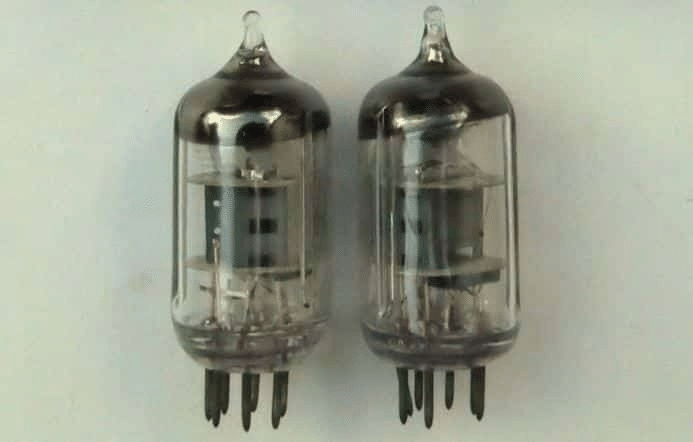
Tube rolling means replacing the tubes in a unit with another make or compatible type to see whether the result suits you better. With small preamp tubes the cost can be low and the swap takes minutes.
It can also go wrong quickly when “same number of pins” is treated as “same tube”.
Meet the small seven pin family
Many compact hybrid products use miniature tubes on a seven pin base known as B7G. Names you will often meet include 6AK5, EF95, 5654, 6J1 and the Russian 6Zh1P.
For the classic types, published data gives the following:
| Item | 6AK5 / EF95 / 5654 family |
| Tube type | Sharp cutoff pentode |
| Base | Miniature seven pin (B7G) |
| Heater voltage | 6.3 V |
| Heater current | 0.175 A |
| Maximum anode dissipation (6AK5) | 1.7 W |
| Maximum anode voltage (6AK5) | 180 V |
| Original purpose | Radio frequency and intermediate frequency stages |
The heater alone uses about 1.1 W per tube (6.3 V multiplied by 0.175 A). A pair therefore draws about 2.2 W before the signal does anything.
The 5654 is regarded as a higher grade relative of the 6AK5, and 6AK5W marks an extended rating version. The 6J1 is commonly offered as a substitute in consumer equipment, but sellers and factories vary. Treat your manual, not a forum list, as the authority.
The compatibility checklist
- Read the unit’s approved list. If the maker names compatible types, start there.
- Match the base. Seven pin tubes do not fit nine pin sockets, and adapters add their own risks.
- Match heater voltage. Check the datasheet. A tube designed for a different heater voltage is not a drop in choice.
- Check heater current. A heavier draw can strain the supply.
- Confirm pin connections. Two seven pin tubes can have completely different internal wiring.
- Buy from a seller who states condition. “New old stock” and “tested” are different claims.
Swapping safely
Switch the unit off and unplug it. Wait until the glass is completely cool, since even small preamp tubes get very hot. Some circuits also hold charge after power is removed, so follow the manual and never open the case unless it tells you to.
Pull the tube straight out with a gentle rocking motion. Avoid twisting. Look at the new tube’s pins and straighten any slight bend with great care. The gap in the pin circle shows the orientation, so line it up before pressing. If it needs force, stop.
On first power up, keep the volume low. Switch off at once if you notice a burning smell, a red glowing metal plate, loud crackling or smoke. Look at the getter, the silvery or dark patch inside the glass: if it has turned white, air has leaked in and the tube must be replaced. A focused purple glow around internal parts can also point to a leak, while a faint blue glow on the inside of the glass is usually harmless.
Judge the change honestly
Expectation is powerful. A new tube you paid for may well sound better to you. A simple routine helps:
- Use the same spoken recording each time, such as an audiobook chapter.
- Keep the volume setting identical, and verify it with a sound level meter if you have one.
- Give each tube the same warm up time.
- Write notes before checking which tube is installed, with help from a second person.
- Compare more than once on different days.
If you cannot tell the tubes apart under those conditions, that is a useful result. Keep the spare as a backup.
What a swap cannot do
A preamp tube in a hybrid design does not increase the output rating of the power stage. It will not repair a faulty speaker or remove noise that enters through a cable. If you are still choosing hardware, check which types a tube amplifier accepts before buying spare tubes for it.
Frequently asked questions
How long do small tubes last? It varies with the tube, the circuit and use. Replace on symptoms such as noise, imbalance or failure to light, not on a fixed calendar.
Should both tubes be changed together? In a two channel circuit, a matched pair of the same type and make helps keep the sides similar.
One tube glows less brightly. Is it faulty? Not necessarily. Visible heater glow differs between constructions. Judge by performance, and test by swapping positions with the power off and tubes cool.
Good tube rolling is mostly patience: read the list, check the ratings, change one thing and compare fairly.