
When you need to understand a business properly, a quick visit to its website usually is not enough. A company may have an impressive homepage, polished products and a long list of achievements, yet there can still be important questions left unanswered. What is its real business model? Who makes important decisions? How is the company performing? What risks could affect it? And where does it stand against competitors?
That is where a research dossier target company approach becomes useful. Instead of collecting random facts from different websites, you build one organised research document around a particular company and a specific purpose. The result can help with investment research, sales preparation, partnerships, recruitment, competitive analysis or early-stage business due diligence.
The important point is that a good dossier is not simply a long company profile. It should turn reliable information into something practical and easy to use.
What Is a Research Dossier for a Target Company?
A research dossier for a target company is a structured collection of relevant information and analysis about a particular business. It normally brings together company facts, leadership information, products, customers, business performance, competitors, market conditions, recent developments, risks and opportunities.
The word “target” can sometimes cause confusion. In this context, a target company does not necessarily mean the American retailer Target. It simply means the organisation that is the subject of your research. The same process can be used for a technology company, retailer, manufacturer, agency, startup, financial business or any other organisation.
What makes a dossier different from a basic company profile is its purpose. A profile might tell you when a company was founded and what it sells. A dossier asks why that information matters. For example, a new CEO could potentially signal a change in strategy, while a major expansion could indicate investment in a particular market.
Current search results for this topic also emphasise that the best dossiers are built around a decision rather than around collecting as many facts as possible.
Why Is Target Company Research Important?
Business decisions become much easier when the available information is organised. Without a proper research process, it is easy to jump between company websites, news articles, financial reports, social profiles and industry publications without developing a clear picture.
A research dossier creates a central reference point. Instead of repeatedly searching for the same information, you can keep important facts, source notes and conclusions together. This can save time when preparing for an important meeting or making a business decision.
The value becomes even clearer when the company is complex. A large organisation may have several brands, markets, executives, business segments and revenue streams. Looking at one piece of information in isolation can be misleading. A dossier helps connect those pieces.
It can also reduce assumptions. Rather than saying that a company is growing because it appears active online, you can look for evidence such as financial results, expansion announcements, hiring activity or product launches.
Start With a Clear Research Objective
Before searching for information, decide exactly what you want the dossier to achieve. This is one of the easiest ways to make company research more useful.
For example, an investor may want to determine whether a company appears financially attractive. A sales professional may want to understand whether the organisation is a suitable prospect. A job candidate may want to learn about the employer before an interview. A potential partner may want to evaluate strategic compatibility.
The objective changes the information you need. A sales dossier may focus heavily on products, business priorities and organisational changes, while an investment dossier may require much more detailed financial and competitive analysis.
Write the main research question at the beginning of the document. Something as simple as “Should this company remain a priority target?” can keep the research focused and prevent the dossier from becoming a collection of unrelated facts.
Confirm the Company’s Identity First
Before researching leadership, revenue or competitors, make sure you have identified the correct company. Similar business names can create surprisingly serious research errors.
Record the company’s legal or commonly used name, official website, headquarters, industry, major markets and primary products or services. If the business has a parent company, subsidiary structure or multiple brands, document that relationship as well.
This step may seem basic, but it protects the rest of the dossier. Information from two different businesses can easily become mixed when their names are similar.
For public companies, additional identifiers such as stock ticker, exchange listing and official filings can help confirm that the research is being performed on the right organisation.
Research the Company’s Background and History
A company’s history provides context for understanding its current position. Start with the founding period, original business purpose and major stages of development.
Look for meaningful milestones rather than trying to document every event. Important acquisitions, market expansions, product launches, leadership changes, rebranding efforts and major strategic shifts are usually more valuable than minor historical details.
The goal is to understand how the company arrived at its current position. A business that started as a small specialist provider and later expanded internationally has a very different story from one that grew through acquisitions.
Keep dates attached to important historical events. This prevents an old development from being mistaken for something that is still happening today.
Examine Leadership and Management
Leadership deserves its own section because executives and boards can have a major influence on business strategy.
Identify current senior leaders where relevant, including the chief executive, finance leadership, operating leadership and important founders or board members. Then look beyond names and titles.
Ask what has changed. Has a new executive recently joined? Has a founder stepped away? Has the company reorganised its leadership structure? Has management communicated a different strategic priority?
Current information is essential here. A company website or old article may still mention someone who no longer holds the same position. For that reason, leadership information should be checked against recent company announcements, filings or other authoritative sources.
Understand the Business Model
One of the most important questions in a research dossier target company project is simple: How does this company actually make money?
Some businesses depend on product sales. Others generate revenue through subscriptions, advertising, licensing, commissions, consulting, transaction fees or a combination of several models.
Understanding the revenue model helps explain other parts of the business. If subscriptions are central, customer retention may be particularly important. If a business depends heavily on physical products, supply chains and inventory may deserve greater attention.
Also identify the company’s main customer groups. A company serving large enterprises has different commercial priorities from one primarily serving individual consumers.
Review Products and Services
Next, identify the products and services that matter most to the organisation.
You do not necessarily need a huge catalogue. Focus on the offerings that explain the company’s position, generate significant revenue, attract customers or represent its future direction.
Look for new launches, product improvements, pricing changes and expansion into related categories. These details can reveal where management is investing attention.
It is also useful to consider the customer problem each product solves. A good dossier should not simply say what a company sells. It should help explain why customers buy it and what makes the offering relevant in its market.
Analyse Financial Information
Financial research is one of the most valuable parts of a company dossier when reliable financial information is available.
Depending on the organisation, useful figures may include revenue, net income, operating income, cash, debt, capital expenditure and segment performance. For public companies, annual reports and quarterly filings can provide particularly useful evidence.
Always include the reporting period with every important number. “Revenue was $10 billion” is incomplete without knowing whether that figure relates to a quarter, fiscal year or another period.
Financial data should also be interpreted carefully. One strong quarter does not automatically prove long-term growth, just as one weak quarter does not necessarily mean a company is failing. Look for patterns across multiple reporting periods whenever possible.
Study Competitors and Market Position
No company exists in isolation. Understanding its competitors gives the dossier important context.
Start by identifying direct competitors offering similar products or services. Then consider indirect alternatives that may solve the same customer problem differently.
Compare factors such as pricing, product range, geographic reach, customer segments, technology, brand positioning and distribution.
Be careful with conclusions. Calling a company the “best” competitor without defining the measurement does not add much value. A stronger analysis explains where the company appears stronger, where it faces pressure and which market changes could affect its position.
Look at Recent Company Developments
A dossier can become outdated surprisingly quickly. Leadership changes, acquisitions, product launches, funding events and strategic announcements can change the picture within months.
Create a recent developments section and attach dates to important events. Depending on the company, this could include earnings announcements, expansion plans, partnerships, restructuring, new offices, product releases, acquisitions or major investments.
Recent news should not automatically be treated as proof of future success. Instead, consider what the development could mean and whether other evidence supports that interpretation.
This distinction between reported facts and analytical conclusions is an important part of professional research.
Identify Risks and Potential Opportunities
A balanced dossier should cover both positive and negative factors.
Potential risks can include intense competition, declining demand, rising costs, regulatory changes, supply-chain problems, technology disruption, debt exposure or dependence on a small number of customers.
Opportunities might include expansion into new markets, new products, growing demand, technological improvements, strategic partnerships or underserved customer segments.
Avoid presenting speculation as fact. If a risk is only a possibility, describe it as a possibility. If an event has already been confirmed, present it as a fact and provide its date and source.
This approach makes the dossier more credible and useful for decision-making.
How to Build a Research Dossier Step by Step
A practical process can make the research much faster.
First, define the decision you are trying to support. Second, confirm the company’s identity. Third, gather basic company information. Fourth, examine leadership, business model and products. Fifth, review financial and market information where available.
After that, investigate competitors, recent developments, risks and opportunities. Finally, review your evidence and turn the most important findings into clear conclusions.
Do not start by trying to collect everything. Start with the questions you need to answer and work backwards.
Current search results for this topic similarly recommend beginning with the decision or objective, followed by company identity, leadership, financial position, competitors, recent signals and implications.
What Sources Should You Use?
The quality of a research dossier depends heavily on the quality of its sources.
For public companies, official filings, investor-relations pages and company announcements can provide important primary evidence. Government databases and regulatory records can also be useful depending on the country and industry.
Reputable business publications can add context, especially for recent developments. Industry reports, trade publications and independent research may help explain market trends and competition.
Company social-media accounts can show announcements and public messaging, but they should not automatically be treated as independent verification.
The strongest approach is to compare important claims across reliable sources rather than trusting the first result that appears in a search engine.
Can AI Help With a Target Company Dossier?
AI can make research faster, but it should not replace verification.
An AI system can help organise notes, identify research categories, summarise lengthy documents, create comparison frameworks and turn raw information into a readable structure.
The problem comes when generated information is accepted without checking. AI can misunderstand dates, combine information from different companies or present an outdated detail as current.
Use AI as a research assistant rather than the final authority. Verify important financial, legal, leadership and corporate claims against appropriate sources before publishing or making a significant decision.
This is especially important when the dossier will influence investment, acquisition, legal, employment or other high-impact decisions.
Common Mistakes to Avoid
One of the biggest mistakes is collecting too much irrelevant information. A twenty-page document is not automatically better than a five-page one.
Another common problem is relying on outdated information. Company leadership, financial performance, products and strategies can change quickly.
Researchers should also avoid copying promotional language directly from company websites. Marketing claims can be useful context, but they should be distinguished from independently verified facts.
Finally, avoid researching private personal information that has no legitimate business relevance. A professional company dossier should focus on the organisation, its public business activities and relevant professional information rather than unnecessary personal details.
A Simple Research Dossier Template
A reusable structure can make future research much easier.
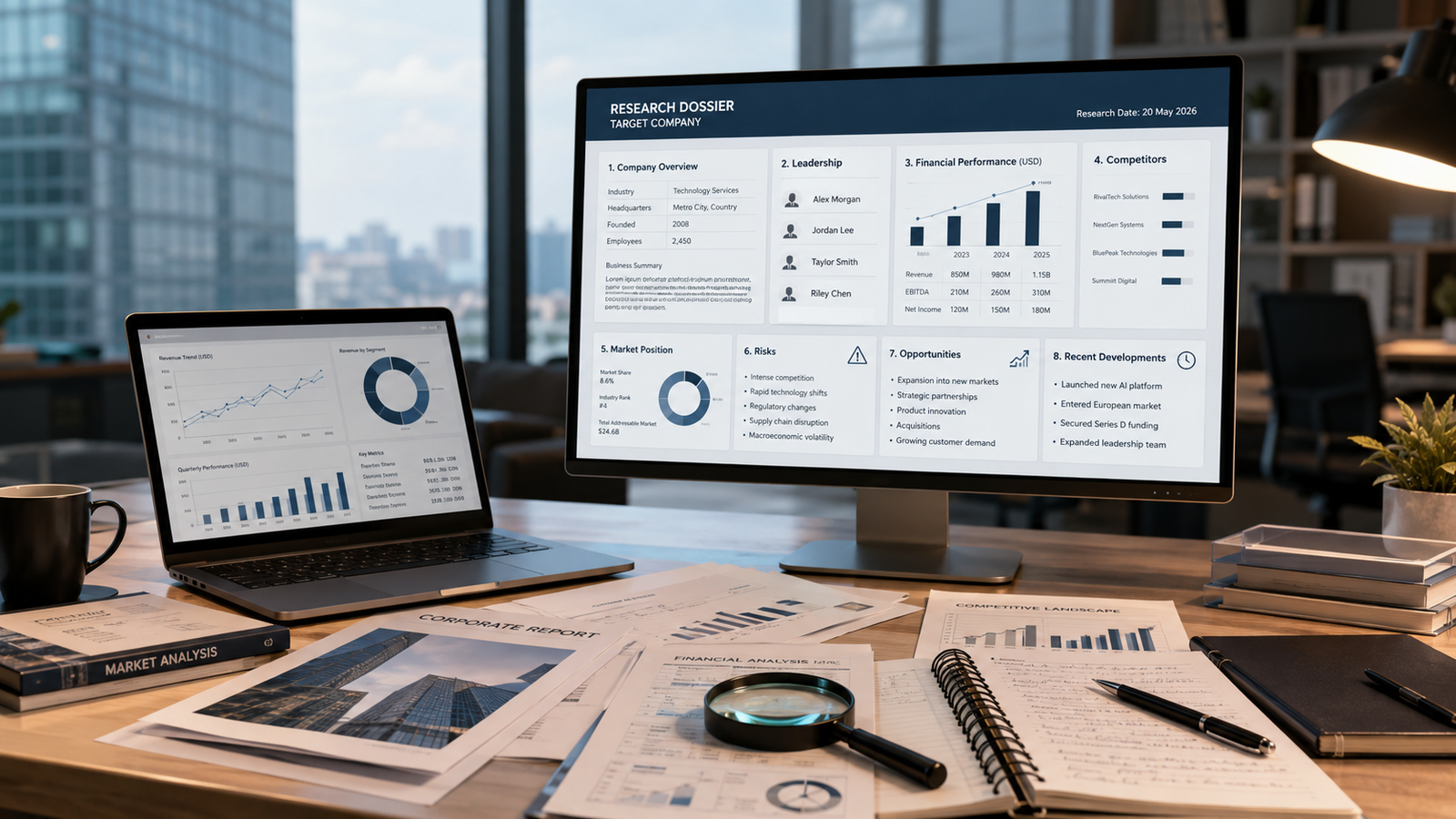
Start with an executive summary explaining the company and the purpose of the research. Then include company facts, history, business model, products and customers.
Next, add leadership, financial information, competitors, market conditions and recent developments. Follow those sections with risks, opportunities and key findings.
Finish with the research date and a source list.
A simple structure could look like this:
Research objective
Executive summary
Company overview
History and ownership
Leadership
Business model
Products and services
Customers and markets
Financial position
Competitors
Recent developments
Risks and opportunities
Key findings
Recommended next steps
Sources and research dates
This structure can be adjusted depending on the purpose of the dossier.
How to Make the Dossier More Useful
The best dossiers answer the “so what?” question.
Finding out that a company launched a new product is useful. Understanding why that launch matters is even more useful.
For example, a new product could indicate expansion into a new customer segment. A new executive could signal a strategic shift. Increased capital spending could suggest investment in future growth. A restructuring announcement could indicate pressure to improve efficiency.
These interpretations should be clearly labelled as analysis rather than presented as confirmed facts.
A useful dossier therefore contains three layers: what is known, what the evidence may indicate and what remains uncertain.
That approach makes the document easier to trust and easier to update.
Is a Research Dossier the Same as Due Diligence?
Not exactly.
A research dossier can support early-stage business analysis and decision-making, but formal due diligence may involve much deeper investigation.
An acquisition due-diligence process, for example, could examine contracts, tax records, intellectual property, liabilities, regulatory matters, financial statements and operational systems that may not be publicly available.
A public research dossier should therefore be treated as a structured research tool, not automatically as a substitute for professional legal, financial or transaction due diligence.
The distinction matters because the level of evidence required depends on the decision being made.
Who Can Benefit From a Target Company Dossier?
Many professionals can use this type of research.
Investors can use it to understand a company’s business and competitive environment. Sales teams can prepare for important accounts. Consultants can learn about potential clients. Partnership teams can evaluate strategic fit.
Job candidates can also create a simpler version before an interview. Instead of focusing heavily on financial details, they might study the company’s products, customers, competitors, leadership and recent announcements.
Researchers and students can use the same framework when comparing organisations or studying a particular industry.
The format stays similar, but the questions change according to the purpose.
Final Thoughts on Research Dossier Target Company
A research dossier target company project is most valuable when it turns scattered information into a clear decision-making resource.
Start with a specific objective. Confirm the company. Research its history, leadership, business model, products, financial position, competitors and recent developments. Then examine risks and opportunities while keeping facts separate from interpretation.
The quality of the dossier matters more than its length. A concise document filled with current, relevant and verifiable information can be far more useful than a huge report packed with outdated facts.
Most importantly, keep the research current. Companies change, executives move, financial results are updated and strategies evolve. A dossier should therefore be treated as a living research document rather than something that is created once and forgotten.
When built carefully, a target company dossier can provide a much clearer view of a business and help turn research into smarter, better-informed action.
You May Also Raed: Stealthgram