
If you have searched for “upgrade oxzep7 python”, you may be expecting a simple command that updates a package and gets everything working again. In reality, the phrase is more complicated than it first appears. Current online information about Oxzep7 is inconsistent, and there is not enough reliable public documentation to confidently describe it as a standard, widely recognised Python package.
That does not necessarily mean the term is useless. It could refer to a private project, an internal dependency, a custom Python component, a local module, or another software identifier used within a particular development environment. The important point is to identify what Oxzep7 actually represents before making changes to your Python installation. This guide explains how to approach an upgrade safely without relying on unverified commands or assumptions.
What Does Upgrade Oxzep7 Python Actually Mean?
The phrase “upgrade oxzep7 python” appears to describe updating a Python-related component called Oxzep7. However, it should not automatically be treated as an official Python command. Python has its own established tools for managing packages, environments, and versions, while third-party software normally has identifiable documentation, package information, release history, and a recognised distribution source.
Current search results show conflicting descriptions of Oxzep7. Some online articles present it as a Python package, development framework, or specialised software component, while other sources point out that its public identity cannot be reliably verified. That distinction is important because developers should never install unfamiliar software simply because a search result provides a command.
If Oxzep7 is part of an existing project, the best starting point is your own development environment. Search dependency files such as requirements.txt, pyproject.toml, Pipfile, or lock files. You can also search the project source code for references to oxzep7. This can reveal whether it is an actual dependency, a local module, or simply a term appearing in documentation.
Another possibility is that Oxzep7 belongs to a private software ecosystem. Companies frequently maintain internal Python packages that are not published publicly. In that situation, the correct upgrade instructions should come from the project’s documentation, internal package registry, repository, or development team rather than a random website.
Is Oxzep7 a Verified Python Package?
One of the biggest challenges surrounding upgrade oxzep7 python is the lack of consistent public information. A well-established Python package normally leaves a fairly clear trail. Developers can usually find a package index entry, source repository, maintainer information, release history, documentation, installation instructions, and dependency details.
The current search results do not provide enough authoritative evidence to confidently establish Oxzep7 as a mainstream public Python package. Several recent pages make the same basic observation, warning developers to verify the package before attempting an upgrade. This means that a command such as pip install –upgrade oxzep7 should not automatically be considered correct.
That does not prove that nobody uses software called Oxzep7. A private organisation could have an internal package with exactly that name. It could also be distributed through a private PyPI-compatible server, Git repository, internal artifact platform, or local package file. The absence of a public package listing therefore needs to be interpreted carefully.
The safest approach is to identify the origin of the name. If it appears in your company’s dependency file, ask where that dependency is hosted. If it appears in a Git repository, inspect its package configuration. If it came from a tutorial or third-party article, look for the original project documentation before installing anything.
What Should You Check Before an Oxzep7 Upgrade?
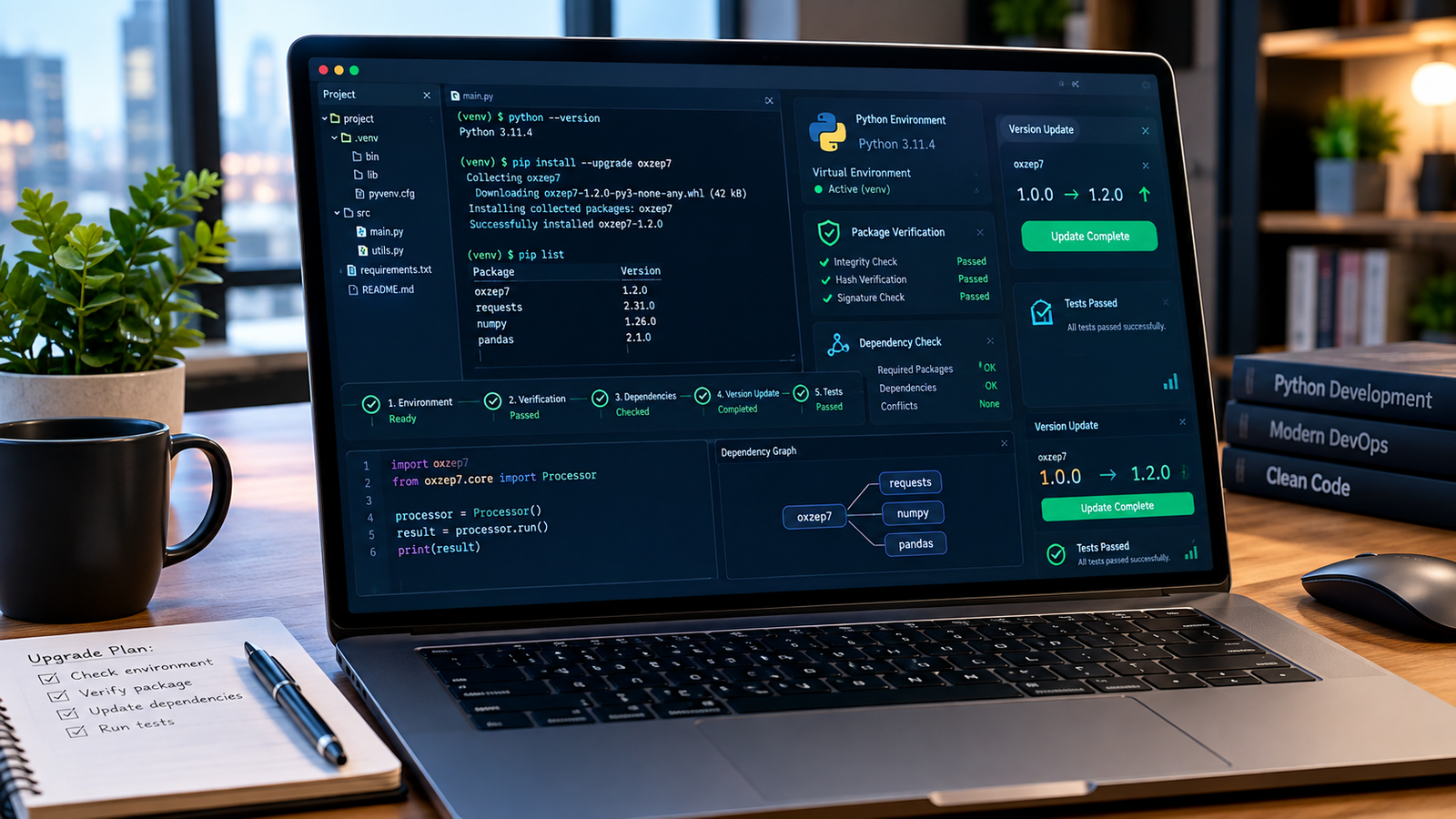
Before attempting any upgrade, start by checking which Python interpreter your project is actually using. Run python –version or, depending on your operating system, python3 –version. Then check the associated pip installation with python -m pip –version. This helps prevent a common problem where a developer updates one Python environment but runs the application from another.
Next, inspect the project’s dependency configuration. Look through files such as requirements.txt, pyproject.toml, setup.py, Pipfile, poetry.lock, or uv.lock. If Oxzep7 is mentioned, determine whether the name is a package distribution, an imported module, or an internal component. These details can completely change the correct upgrade procedure.
It is also sensible to create a record of the current environment before making changes. A command such as python -m pip freeze > requirements-before-upgrade.txt can preserve the currently installed package versions. If the upgrade causes unexpected behaviour, this record gives you a useful reference for troubleshooting and recovery.
A virtual environment is another important part of a safe workflow. You can create one with python -m venv .venv and activate it before testing changes. This isolates the project from unrelated Python installations and makes it easier to experiment without accidentally changing packages used by other applications.
How to Upgrade a Verified Python Dependency
If your investigation confirms that Oxzep7 is a legitimate package and you know its trusted distribution source, the upgrade should follow the documentation provided by the package owner. For a normal pip-managed dependency, the standard pattern is:
python -m pip install –upgrade package-name
The important part is the package name. Do not replace package-name with oxzep7 unless you have independently verified that oxzep7 is the correct distribution identifier.
If Oxzep7 is an internal package, the command may be different. Your organisation might use a private package index, Git repository, enterprise artifact server, or another distribution system. In such cases, blindly using public pip sources could install the wrong software or create unnecessary security and dependency risks.
You should also test the upgrade outside production first. Create a separate virtual environment or testing branch, install the required dependencies, and run the project’s automated tests. If the software is business-critical, compare application behaviour before and after the change rather than assuming that a successful installation means the upgrade is complete.
A successful package installation only tells you that the package manager completed its task. It does not guarantee that your application, scripts, plugins, APIs, or other dependencies remain compatible.
Should You Run pip install –upgrade oxzep7?
This is probably the most important question for anyone searching for upgrade oxzep7 python. The short answer is: not blindly.
The command python -m pip install –upgrade oxzep7 looks like a normal Python upgrade command. However, the appearance of a command does not prove that the package exists under that exact distribution name or that the package is trustworthy. Current online sources specifically disagree about the public identity of Oxzep7, which makes verification especially important.
Before running the command, verify the package source, current version, maintainer, documentation, and distribution method. If the package is part of an internal project, confirm the correct repository or package index with the project’s documentation.
There is another reason to avoid copying commands from random articles. Package names can be confusing, and installing an unrelated package can introduce dependency conflicts or potentially unwanted software. A familiar-looking pip command is not a substitute for knowing what you are installing.
The safer principle is simple: verify first, upgrade second.
How to Troubleshoot Python Problems After an Upgrade
If an upgrade has already been performed and the application is behaving differently, begin with the basics. Check the Python version, confirm that the intended virtual environment is active, and inspect the installed packages with python -m pip list or python -m pip freeze.
Dependency problems are another common source of failures. Run python -m pip check to identify packages with incompatible or missing dependencies. If the command reports a conflict, investigate which package introduced it instead of randomly downgrading several dependencies at once.
Import errors can also indicate that the wrong environment is being used. For example, an application may report that a module cannot be found even though the developer believes it has been installed. Checking python -m pip –version alongside python –version can help establish whether the same interpreter is being used for both installation and execution.
If the project uses Git, compare the changes made during the upgrade and test from a clean environment. This is often easier than trying to repair a heavily modified development installation. Keeping dependency files and lock files under version control also makes future upgrades more predictable.
Best Practices for a Safer Python Upgrade
The safest upgrade process starts with preparation. Record the current environment, create a dedicated testing environment, verify the package source, and understand which Python version the project supports. These steps may seem slower than immediately running an upgrade command, but they can save significant troubleshooting time later.
Never treat search-engine results as authoritative package documentation. Search results can contain duplicated or speculative information, particularly for obscure software names. The current Oxzep7 search landscape is a good example because different pages describe the term in different ways.
It is also wise to test upgrades in stages. Upgrade the Python runtime only when necessary, update dependencies deliberately, and run automated tests after meaningful changes. If the application is deployed to production, use a staging environment before releasing the updated configuration.
Finally, document what you changed. Record the old and new versions, commands used, dependency changes, test results, and any configuration adjustments. Good upgrade documentation turns a one-time technical task into a repeatable process for future maintenance.
Final Thoughts on Upgrade Oxzep7 Python
Searching for upgrade oxzep7 python may make the task appear straightforward, but the available public information suggests that the first step should be identification rather than installation. There is currently not enough consistent evidence to treat Oxzep7 as a universally recognised Python package with a standard upgrade command.
If Oxzep7 is part of your project, find its actual source first. Check dependency files, repositories, internal package registries, and project documentation. Once you know what it is and where it comes from, you can select the correct upgrade method.
Most importantly, avoid blindly copying pip install –upgrade oxzep7 from an unfamiliar website. A safe Python upgrade is based on verified dependencies, isolated environments, testing, and clear rollback information. That approach may take a few extra minutes, but it is far more reliable than guessing what an unfamiliar package name means.
You May Also Raed: Stealthgram