
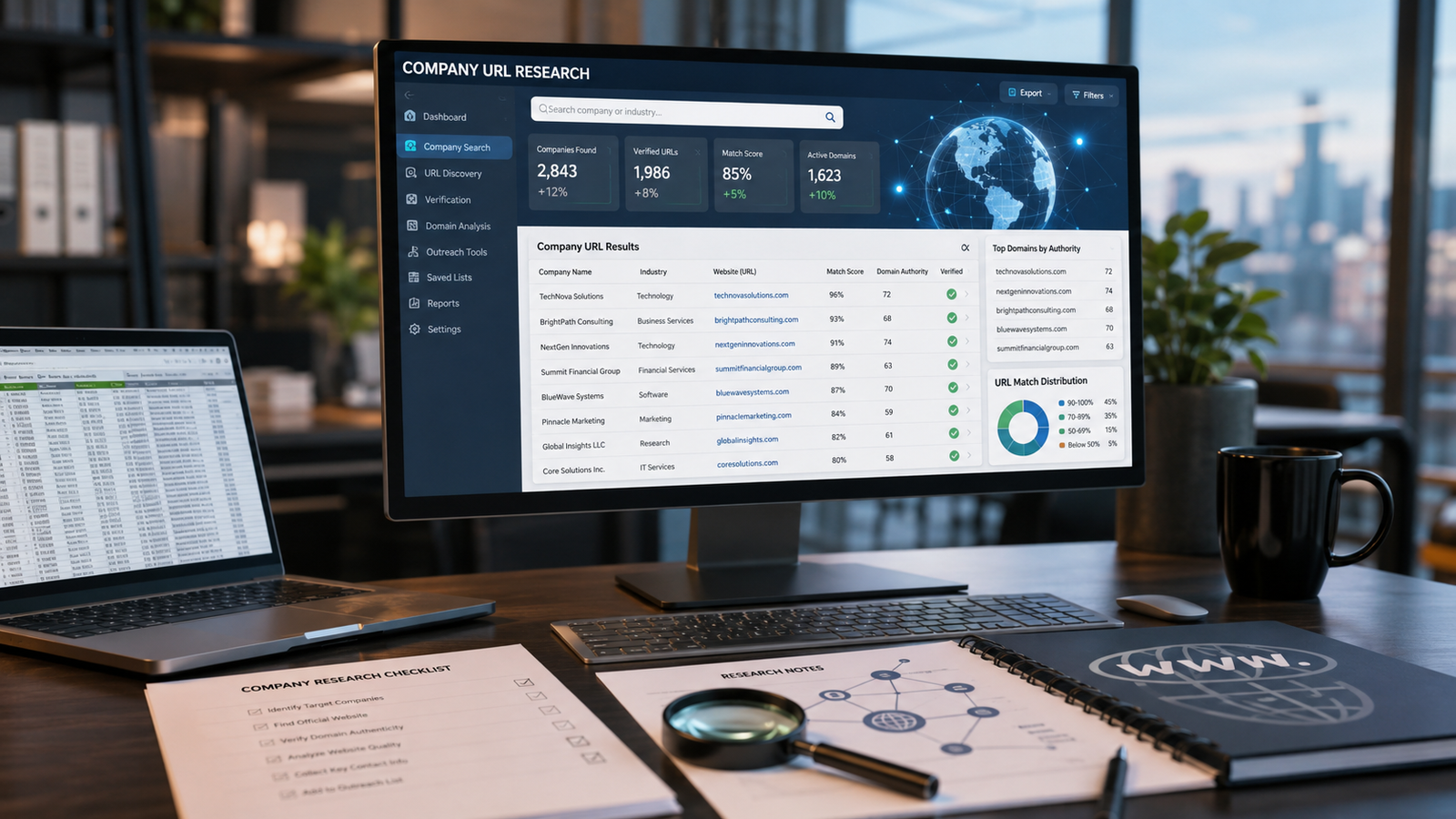
When you have a long list of businesses, finding the correct website for every company can become surprisingly time-consuming. A company name may look simple, but similar names, different locations, brand names, and outdated records can quickly make the research process confusing. This is where target company URL research becomes useful.
Target company URL research is essentially the process of taking a company name and identifying the website or domain that belongs to the intended business. It can be useful for B2B sales, recruiting, market research, SEO, lead generation, data cleaning, and prospecting. A dedicated tool such as TargetCompanyURLResearch.com is designed around this exact workflow, allowing users to enter multiple company names and review possible website matches.
What Is Target Company URL Research?
Target company URL research means finding the official online address of a business that you want to investigate. In a simple example, you may have a spreadsheet containing company names but no website information. Before you can analyse those businesses, you need to connect each name with the correct domain.
This sounds easy when you have only one company to research. You can open a search engine, type the business name, visit the results, and identify the official website. The situation changes when you have 50, 100, or even thousands of companies. Repeating the same process manually can consume hours and increases the possibility of selecting the wrong website.
The important word here is “target.” In B2B research, a target company is simply a business that you are interested in selling to, studying, recruiting from, partnering with, or analysing. It does not necessarily refer to the American retailer Target Corporation. This distinction matters because the phrase is commonly used in sales and marketing workflows.
Why Finding the Correct Company URL Matters
A company name alone does not always provide enough information. Businesses can share similar names, use abbreviations, operate under a brand name, or have separate domains for different countries and business divisions. If you attach the wrong website to a company record, every later research step can become inaccurate.
For sales teams, the website is often the starting point for understanding a prospect. Researchers can review products, services, industries, locations, leadership information, and company announcements. Recruiters can use the domain to locate official career pages, while marketers can use it to understand a prospect’s business model and online presence.
Clean URLs are also important for CRM and spreadsheet management. A database filled with incorrect or duplicate domains creates problems later. Good target company URL research helps turn a basic company list into a more useful dataset that can support the next stage of research.
How a Company URL Research Tool Works
The basic process is straightforward. A user enters company names, usually one name per line, and the system searches for potential matching businesses and domains. TargetCompanyURLResearch.com currently supports bulk lookup of up to 25 names per run and displays the entered name, returned company name, domain, and match information.
One useful part of the process is name cleaning. Company records often contain legal endings such as Inc, Ltd, LLC, PLC, or GmbH. Removing unnecessary legal suffixes can make matching more practical because people generally search using a company’s trading or brand name.
The results should still be reviewed rather than accepted blindly. A strong match is encouraging, but similar company names can produce multiple possibilities. The website explains that its match score represents name similarity rather than absolute proof that a particular domain belongs to the company you intended to research.
How to Research Target Company URLs Step by Step
Start by preparing your company list. If the names are stored in Excel or Google Sheets, clean obvious duplicates before beginning. Keeping one company per line makes the process easier and gives you a simple list that can later be compared against the returned results.
Next, enter the names into the lookup tool. After processing, review the returned domains and matching company names. High-confidence results can usually move quickly through your workflow, while uncertain matches deserve a closer look. The official tool recommends checking medium- and low-match results before importing them into a CRM.
Finally, verify important results manually. Open the domain and check whether the website actually represents the business you intended to research. Look for company information, branding, products, locations, and contact details. This final step is especially important when the company name is common or ambiguous.
Dealing With Similar Company Names
Similar names are one of the biggest challenges in company URL research. Imagine you are researching a business called “Atlas.” There may be technology companies, logistics firms, manufacturers, financial businesses, and other organisations using that name. Selecting the first domain you see is not a reliable research method.
Location can help solve this problem. If your original company list includes a country, city, industry, or other identifying information, use that information when evaluating the results. A domain that belongs to a software company in the United States may be completely unrelated to a manufacturing company with the same name in another country.
The same principle applies to short names and abbreviations. A result can look convincing simply because the words are similar. That does not necessarily mean it is the right business. When there are alternatives, compare the company identity before making the result part of your permanent dataset.
Using Company URL Research for B2B Sales
Sales teams can benefit significantly from organised company URL research. A prospecting list may begin with nothing more than company names collected from directories, events, referrals, or previous campaigns. Adding the correct domains gives sales researchers a starting point for deeper qualification.
Once the domain is identified, a salesperson can examine the company’s products, target market, industries served, locations, and recent business activity. This makes outreach more relevant because the salesperson understands what the company actually does rather than relying only on a name in a spreadsheet.
The process can also help sales operations teams keep CRM records cleaner. Instead of manually searching every prospect, researchers can perform the initial URL identification in batches and then focus their time on verifying uncertain records and gathering higher-value information.
How Recruiters Can Use Company URL Research
Recruiters have a similar need. A candidate may be interested in a company, but the business name alone does not always make it easy to locate the official employer website. Once the domain is identified, the recruiter can move directly into researching the organisation.
A company URL can also make it easier to locate career information. TargetCompanyURLResearch.com includes a Careers Page Finder that builds common career-page URL patterns from a company domain. However, the site makes clear that this feature does not provide live job listings or guarantee that every generated link will exist.
That distinction is useful. A career URL finder should be treated as a shortcut to the official website, not as a replacement for checking the company’s actual careers page. The final verification should always happen on the employer’s own site.
Target Company URL Research for SEO and Market Research
SEO professionals can also find company URL research useful during competitor and market analysis. Suppose an SEO specialist has a list of businesses operating in a particular niche. Finding their official domains is an early step before analysing their websites, content, backlinks, technical structure, or search visibility.
It can also be useful when building market maps. Once company names have been connected with domains, researchers can organise businesses by industry, location, business model, or other characteristics. The domain becomes a practical identifier that connects different pieces of information.
However, URL research should not be confused with full SEO research. Finding a domain does not automatically provide traffic data, keyword rankings, backlinks, revenue, employee numbers, or detailed company intelligence. Those tasks require additional research and specialised data sources.
How to Verify a Company URL Before Using It
Verification is one of the most important parts of the entire process. Even if a tool returns a high-quality match, open the website and inspect it before adding the information to an important database.
Check whether the website uses the expected company name and branding. Look for an About page, contact information, product or service descriptions, and location details. If the company operates in a specific industry, make sure the website reflects that industry.
You can also compare information from multiple sources when accuracy is particularly important. A company directory, professional profile, official social account, or government business record may provide additional clues. The more valuable the final dataset is, the more worthwhile this verification step becomes.
Common Mistakes to Avoid
One common mistake is assuming that the first search result must be correct. Search engines rank pages for many reasons, and the first result may be a directory, review site, social profile, or similarly named business instead of the official company website.
Another mistake is ignoring regional differences. Some international businesses use country-specific domains or regional subdomains. If you are researching a company for a particular market, make sure the website you choose matches the geographic context of your project.
The third mistake is trusting a match score as if it were a guarantee. Match scores can make research faster, but they should be viewed as an indicator rather than final evidence. TargetCompanyURLResearch.com itself explains that its score reflects how closely company names match, not definitive ownership verification.
Benefits of a Structured URL Research Workflow
A structured workflow makes company research more efficient because it separates simple tasks from complex ones. Instead of manually researching every company from scratch, you can first identify likely domains in bulk and then spend your time checking the results that actually require attention.
This approach also improves consistency. Every company can be evaluated using the same basic process: identify the domain, review the match, verify the website, and record the final result. Consistency becomes especially important when multiple people are working on the same prospecting or research project.
There is also a productivity advantage. According to the tool’s own description, users can process up to 25 names per run, export results as CSV, and review alternative matches when available. This can make the first stage of large-scale company research considerably more manageable.
Final Thoughts on Target Company URL Research
Target company URL research may sound like a small part of business research, but getting the website right can influence everything that comes afterward. Whether you are working in B2B sales, recruiting, SEO, market research, or data management, the correct domain gives you a reliable starting point for understanding a business.
The smartest approach is not to treat automated results as unquestionable answers. Use them to reduce repetitive work, identify likely domains, and organise your research. Then manually verify the results that matter, particularly when company names are common or multiple businesses appear to match.
In short, good target company URL research combines speed with verification. Automation can handle the repetitive part, while human judgement handles the ambiguous cases. That balance gives you cleaner company data, a more efficient workflow, and a much stronger foundation for deeper business research.
You May Also Raed: Stealthgram